
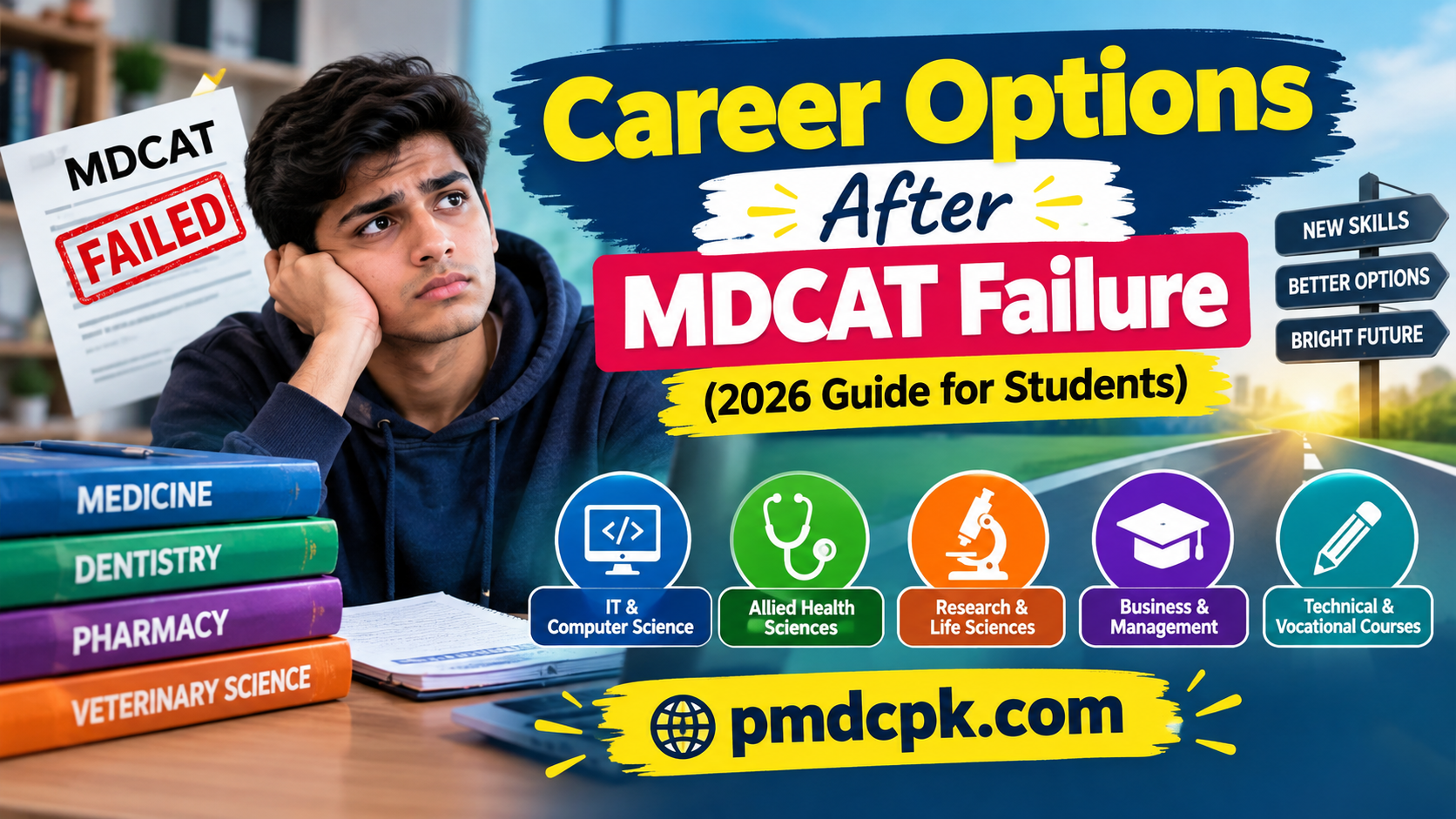
Not getting admission to an MBBS or BDS program can be disappointing, especially when you have spent years preparing for a medical career. After the MDCAT result, many students feel uncertain about their future. Some consider repeating the examination, while others wonder whether they should choose a different degree altogether.
However, missing the medical college merit cutoff does not mean that your education has reached a dead end. Pakistan offers several degree programs in healthcare, pharmaceutical sciences, biotechnology, computing, and other professional fields that can lead to meaningful careers.
The important decision is not simply whether to repeat the MDCAT. It is whether another attempt makes sense for your academic position, financial circumstances, personal interests, and long-term goals.
This guide explores what students can do after missing MBBS or BDS admission in Pakistan, which alternative degrees deserve consideration, and how to make a well-informed decision without wasting valuable time.
1. What Should You Do After Missing MBBS Admission?
Before selecting a new degree or preparing for another attempt, give yourself time to understand your options. Making an important educational decision immediately after receiving disappointing results can lead to unnecessary pressure.
Follow these practical steps.
Step 1: Review Your MDCAT and Aggregate
Calculate your admission aggregate using the official formula applicable to your admission cycle. Compare your aggregate with the relevant college’s published merit lists, where available.
Check whether the difference between your aggregate and the closing merit was small or substantial. Also consider your performance in FSc or equivalent examinations and identify the subjects that need improvement.
A small difference does not guarantee admission in the next cycle. Merit changes according to applicants’ results, available seats, admission policies, and other factors.
Step 2: Decide Whether Another Attempt Is Worthwhile
Repeating the MDCAT may be reasonable if you genuinely want to study medicine, understand what went wrong, and have a realistic preparation plan.
Before committing another year, ask yourself:
- Can I identify specific weaknesses that affected my previous result?
- Can I improve those areas through a different study strategy?
- Can I manage the financial and academic consequences of another attempt?
- Am I interested in becoming a doctor, or am I continuing mainly because of family or social expectations?
Your answers can help you distinguish between a carefully planned second attempt and a decision driven primarily by disappointment.
Step 3: Explore Alternative Admissions Immediately
Do not wait until the next MDCAT cycle to investigate other degrees. Universities may have different application deadlines, eligibility requirements, and entry tests.
Explore Pharm-D, Nursing, Allied Health Sciences, Biotechnology, Bioinformatics, and other suitable programs. Shortlist institutions according to accreditation, curriculum, clinical training, fees, location, and graduate opportunities.
Important: Missing MBBS admission does not automatically require taking a gap year. You can consider another degree while keeping your long-term academic goals in mind.
2. Is Repeating MDCAT Better Than Choosing Another Degree?
There is no single answer for every student. The better choice depends on your circumstances rather than the number of attempts you have already made.
| Factor | Consider another MDCAT attempt | Consider an alternative degree |
|---|---|---|
| Career interest | You strongly prefer clinical medicine | You are open to other professions |
| Previous result | You have identifiable areas to improve | Your interests have shifted |
| Preparation | You can follow a structured revision plan | You want to begin university studies |
| Financial position | Another attempt is manageable | Further preparation creates significant financial pressure |
| Long-term plan | You understand the training required after MBBS/BDS | You have identified a suitable alternative career |
If you have attempted the examination multiple times, do not decide solely because you have already invested years in preparation. Past effort cannot be recovered by repeating the same process indefinitely.
Instead, evaluate the likely benefits, costs, and alternatives available to you now. Speaking with a university admissions adviser or career counsellor may help you make a more objective decision.
3. Best Healthcare Degrees After FSc Pre-Medical Without MBBS
Students who enjoy Biology and want to work in healthcare do not necessarily need to abandon the medical sciences.
Several degree programs provide routes into patient care, rehabilitation, diagnostics, pharmaceutical development, and health research. However, admission requirements vary by university, so confirm the relevant criteria before applying.
1. Doctor of Pharmacy (Pharm-D)
<text>Typical duration: Five years</text>
Pharm-D focuses on medicines, their effects, safe use, preparation, and appropriate management. It can suit students who enjoy Chemistry, Biology, and understanding how medicines work.
Potential career areas include:
- Hospital and clinical pharmacy, subject to the relevant requirements.
- Pharmaceutical manufacturing and quality assurance.
- Drug regulation and regulatory affairs.
- Pharmaceutical research and development.
- Community pharmacy and medicine-related services.
Employment opportunities depend on professional registration, practical experience, the employer, and the local job market. Students should check the recognition and accreditation of the pharmacy program before enrolling.
2. BS Nursing
<text>Typical duration: Four years for the standard BS Nursing degree</text>
Nursing is a professional healthcare pathway focused on patient care, clinical procedures, health education, and supporting treatment plans.
Graduates may pursue opportunities in hospitals, community health services, specialist care units, and other healthcare settings.
Nursing can also provide international career opportunities, but working abroad requires meeting the destination country’s registration, language, qualification, and immigration requirements. No degree automatically guarantees overseas employment.
Students should confirm that their chosen nursing institution and program are recognized by the relevant authorities.
3. Doctor of Physical Therapy (DPT)
<text>Typical duration: Five years</text>
Physical therapy focuses on movement, mobility, rehabilitation, and improving physical function. It may appeal to students who enjoy anatomy, exercise science, and working directly with patients.
Possible career settings include:
- Rehabilitation centres.
- Hospitals and outpatient clinics.
- Sports and musculoskeletal rehabilitation services.
- Community rehabilitation programs.
- Further study and specialized clinical practice.
Building practical competence and gaining supervised clinical experience are important for professional development. Independent practice must follow applicable professional and legal requirements.
4. BS Medical Laboratory Technology
<text>Typical duration: Commonly four years</text>
Medical Laboratory Technology, often called MLT, is a suitable option for students interested in laboratory investigations rather than direct bedside care.
The program generally covers laboratory procedures, diagnostic testing, specimen handling, and quality control.
Graduates may pursue work in diagnostic laboratories, hospitals, blood banks, research facilities, and laboratory quality-management services.
When comparing institutions, investigate the availability of modern laboratory equipment, supervised practical training, and recognition by the relevant authorities.
5. BS Medical Imaging Technology
<text>Typical duration: Commonly four years</text>
Medical Imaging Technology prepares students for technical roles involving diagnostic imaging equipment and related patient procedures.
Depending on the curriculum and employment requirements, career settings may include hospital imaging departments, diagnostic centres, and specialist medical facilities.
Students should review the program’s clinical placements, equipment access, recognition, and practical training opportunities before choosing an institution.
4. Career Options in Biotechnology and Modern Health Sciences
Students who prefer laboratory research, scientific investigation, or working with biological data may find interdisciplinary degrees more suitable than conventional clinical programs.
BS Biotechnology
Biotechnology applies biological knowledge to areas such as medicine, agriculture, food production, industrial processes, and scientific research.
Potential career areas include laboratory research, quality control, pharmaceutical support, agricultural biotechnology, and further postgraduate study.
The availability of research positions can vary considerably. Students interested in advanced scientific careers should investigate research facilities, laboratory experience, internships, and postgraduate opportunities.
BS Biochemistry
Biochemistry examines the chemical processes occurring in living organisms. It combines aspects of Biology and Chemistry and may appeal to students interested in understanding cellular processes, proteins, enzymes, and metabolism.
Graduates may explore laboratory work, research support, pharmaceutical-related industries, and further study. Some specialized positions require additional qualifications or relevant experience.
BS Bioinformatics
Bioinformatics combines biological science with computing and the analysis of biological data.
Students may study programming, statistics, biological databases, genomics, and computational methods. Career directions can include bioinformatics analysis, research data management, computational biology, and further study in related fields.
This option is particularly worth investigating if you enjoy Biology but are also willing to develop mathematical, statistical, and programming skills.
5. Can Pre-Medical Students Switch to Computer Science?
Yes, students with a pre-medical background may be eligible for certain computing programs, depending on the applicable university and regulatory requirements.
Possible fields include:
- BS Computer Science.
- BS Software Engineering.
- BS Artificial Intelligence.
- BS Data Science.
- BS Information Technology.
These degrees are not automatically easier than medical studies. They require logical reasoning, problem-solving, consistent practice, and, in many cases, substantial mathematical learning.
Some universities may permit pre-medical applicants subject to mathematics deficiency courses or other conditions. Policies can differ, so verify the current admission criteria directly with the university and the relevant higher-education authorities.
Students who enjoy both technology and healthcare could also explore health informatics, healthcare information systems, and digital health where suitable programs are available.
6. Comparing Alternative Degrees After MDCAT
The following comparison can help you build an initial shortlist. Durations are typical examples rather than universal rules.
| Degree | Typical duration | Main area | Possible career direction |
|---|---|---|---|
| Pharm-D | 5 years | Medicines and pharmacy | Hospital or pharmaceutical industry |
| BS Nursing | 4 years | Patient care | Nursing and clinical services |
| DPT | 5 years | Rehabilitation | Physiotherapy and rehabilitation |
| BS MLT | 4 years | Laboratory diagnostics | Medical laboratories and hospitals |
| Medical Imaging Technology | 4 years | Diagnostic imaging | Hospital imaging departments |
| BS Biotechnology | 4 years | Applied biological sciences | Research and industrial laboratories |
| BS Bioinformatics | 4 years | Biology and computing | Biological data analysis |
| BS Computer Science | 4 years | Computing | Software and technology roles |
| BS Healthcare Management | Commonly 4 years | Healthcare administration | Hospital operations and management |
These degrees differ in admission requirements, professional recognition, job availability, and long-term earning potential. The most suitable option is not necessarily the one with the highest advertised salary; it is the one that fits your interests, abilities, finances, and realistic employment opportunities.
Also Read More About: CSS Result 2026 List Of Pass Candidates
7. How to Choose a Degree with Good Career Potential
Before submitting an application, evaluate the complete program rather than relying on its name or promotional claims.
Check Recognition and Accreditation
Confirm that the university and specific degree program are recognized by the appropriate authorities. For regulated healthcare professions, check the relevant professional council’s requirements.
Compare the Total Cost
Calculate tuition fees, admission charges, transport, accommodation, books, equipment, and other expenses for the full degree. Ask whether scholarships or financial assistance are available.
Investigate Practical Training
A program with appropriate laboratories, supervised clinical placements, internships, and industry connections may provide valuable preparation for employment.
Ask the university about its training arrangements rather than relying exclusively on claims about graduate placement.
Research Actual Job Opportunities
Review recent job advertisements to understand the qualifications, experience, registration, and skills employers request.
If possible, speak with recent graduates and professionals working in the field. Their experiences can help you understand both the advantages and limitations of a career.
Consider Your Own Strengths
A student who enjoys patient interaction may prefer Nursing or DPT. Someone who likes laboratory work may prefer MLT or Biotechnology, while a student interested in programming and data may investigate Computer Science or Bioinformatics.
Your interest in the day-to-day work matters because professional success requires sustained learning after graduation.
8. A Practical 7-Day Action Plan After MDCAT Results
If you are unsure what to do next, use the following one-week plan to organize your decision.
Day 1: Review your position. Calculate your aggregate and check the relevant admission information.
Day 2: Identify your priorities. Decide whether you prefer patient care, laboratory work, pharmaceutical sciences, research, or computing.
Day 3: Shortlist degrees. Choose three to five programs that match your interests and academic background.
Day 4: Check eligibility. Review each institution’s admission criteria, entry tests, and application deadlines.
Day 5: Compare institutions. Investigate accreditation, practical training, fees, location, and available financial assistance.
Day 6: Discuss your options. Talk with your family, a trusted teacher, a career counsellor, or professionals in your shortlisted fields.
Day 7: Make a plan. Apply to suitable programs and decide whether another MDCAT attempt is justified by your circumstances.
You can modify this schedule if admissions are closing soon. In that situation, checking deadlines and preserving viable options should take priority.
Conclusion
Not securing an MBBS or BDS seat can change your plans, but it does not eliminate your opportunity to build a successful professional future.
Students in Pakistan can explore several alternatives after MDCAT, including Pharm-D, Nursing, DPT, Medical Laboratory Technology, Medical Imaging Technology, Biotechnology, Bioinformatics, and computing degrees.
Each option has different educational requirements and career opportunities. Research the program carefully, confirm recognition and eligibility, compare the full cost, and investigate the skills employers actually need.
If you still want to pursue MBBS or BDS, another attempt may be worth considering when you have a realistic improvement plan. If your interests have changed, choosing another degree can be a positive decision rather than a defeat.
Your next step is to select a career that suits your interests and circumstances, then move forward with a clear and informed plan.