
Preparing for MDCAT is not only about learning Biology, Chemistry, Physics, English, and Logical Reasoning. Students must also understand how to record their answers correctly on the test answer sheet. Even when you know the correct answer to a question, an avoidable marking mistake can create confusion during answer-sheet processing.
An Optical Mark Recognition (OMR) sheet is designed to record answers through marks made in designated spaces. If you mark the wrong option, leave a response unclear, or enter candidate details incorrectly, your answer sheet may not reflect your intention.
This guide explains common MDCAT OMR sheet filling mistakes, illustrates how they can happen, and provides a practical routine to follow on test day. The exact answer-sheet layout and marking rules may vary, so always follow the official instructions provided by the relevant test authority for your examination session.
What Is an OMR Sheet in MDCAT?
An OMR sheet is a specially designed answer sheet that allows a system to detect marked responses. Questions generally have multiple-choice options, and candidates record their selected answers in corresponding bubbles or circles.
For example, if Question 12 has options A, B, C, and D, you must identify the correct option and mark the corresponding space for Question 12 on your answer sheet.
The question paper and OMR sheet may be separate. This means you need to keep your question number aligned with the correct answer-sheet row throughout the test.
Understanding this process before entering the examination hall can help you avoid unnecessary errors under time pressure.
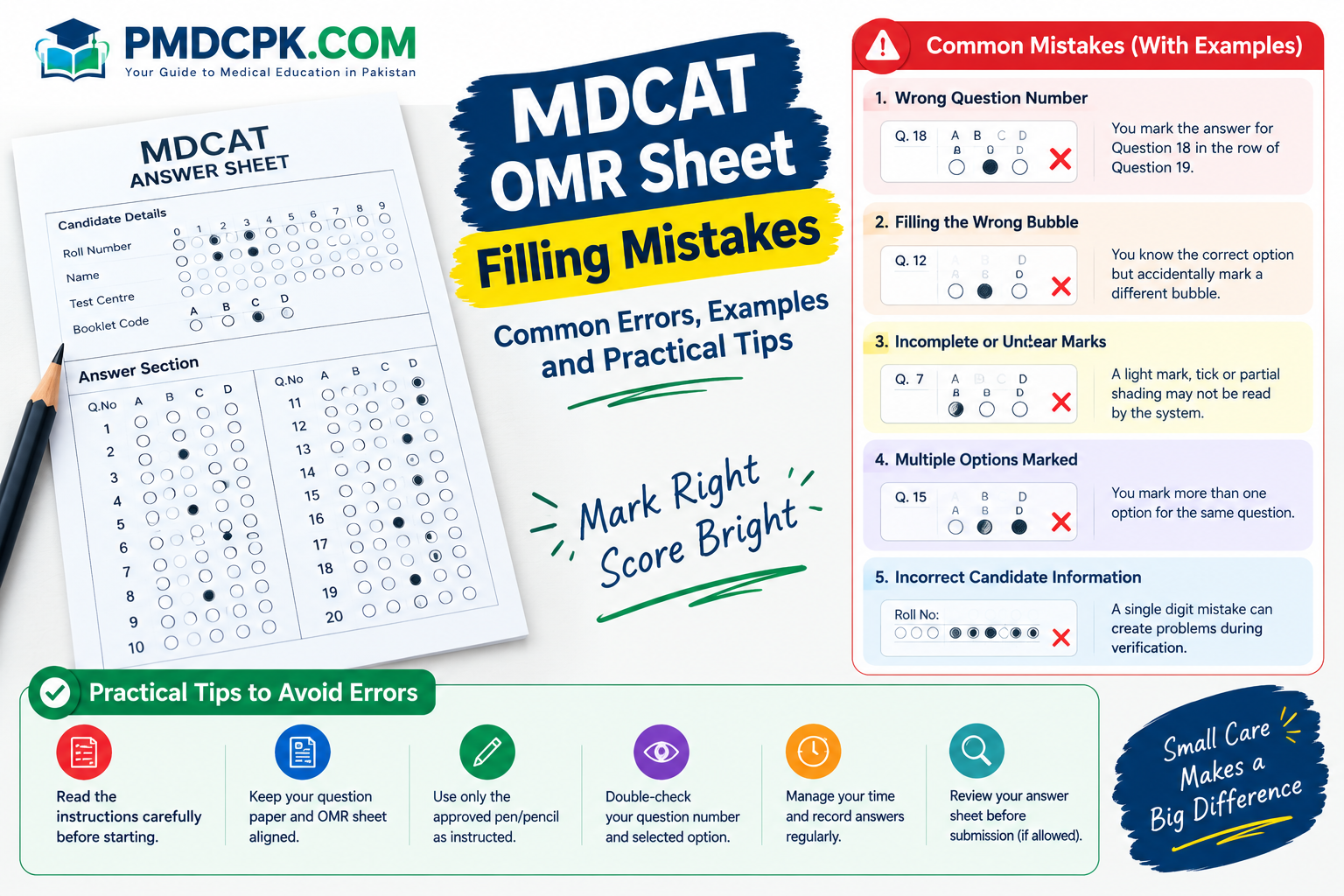
1. Marking the Wrong Question Number
One common mistake occurs when a student answers the correct question on the question paper but marks the next or previous row on the OMR sheet.
Illustrative example
Suppose you are solving Question 18 and determine that option C is correct. However, while transferring your answer, you accidentally mark option C in the row for Question 19.
Your chosen option may be correct for Question 18, but it has been recorded against a different question.
How to avoid this mistake
- Check the question number before marking each answer.
- Keep your question paper and OMR sheet aligned.
- If you skip a difficult question, make sure you return to its correct row later.
- Periodically verify that your answer-sheet row matches your current question number.
Practical tip: Develop a consistent habit of checking the question number first and the selected option second.
2. Filling the Wrong Bubble
Sometimes students understand a question correctly but accidentally shade the wrong option. This can happen when they move quickly between the question paper and answer sheet.
For example, you may conclude that option B is correct but mark option D because you are looking at the wrong row or column.
Before marking an answer, confirm both the question number and the option letter.
A useful mental check is:
Question number → Selected option → Matching bubble
Do not depend only on the position of a bubble. Read its corresponding option label carefully.
3. Making Incomplete or Unclear Marks
OMR sheets are designed to be read according to specific marking instructions. An incomplete mark, a faint line, or an unusual symbol may not be interpreted as you expect.
Students sometimes make a small tick, draw a cross, or shade only part of a bubble because they are rushing.
Better practice
- Use only the writing instrument specified in the official examination instructions.
- Fill the designated response area according to the sample or directions provided.
- Avoid decorative marks, ticks, crosses, or random strokes in answer bubbles.
- Do not assume that a faint or partial mark will be accepted.
The goal is to make each response clear and consistent with the instructions given by the test authority.
4. Marking More Than One Option
A multiple-choice question generally requires one selected response unless the official instructions explicitly state otherwise.
Suppose you believe option A is correct but later change your mind and mark option C as well. The sheet may now contain two marked responses for the same question.
Do not assume that the system will automatically identify your intended answer.
What should you do instead?
Before changing an answer, check the rules printed on the answer sheet or explained by the invigilator. Some examination systems have specific procedures for correcting a response, while others may not permit a correction that leaves multiple marks.
If you are unsure how to correct a mark, ask the invigilator before making additional marks. Never invent a correction method during the examination.
Read More abut: MDCAT Bubble Sheet PDF Free Download
5. Incorrect Candidate Information
Answer-sheet errors are not limited to MCQ responses. Incorrect personal or examination information can also create problems.
Depending on the format, the answer sheet may ask for details such as:
- Candidate name or roll number.
- Examination or booklet code.
- Test centre or other identifying information.
- Candidate signature or other required details.
Enter only the information requested and follow the instructions for writing or marking it.
If a roll number must be represented in individual digit columns, check each digit against your admit card or other official examination document. A single misplaced digit can result in an incorrect entry.
Do not copy personal details from memory when the official document is available for verification.
6. Ignoring the Question Paper or Booklet Code
Some examinations use different question-paper versions or booklet codes. If your examination session requires a booklet code to be recorded on the answer sheet, it is important to follow the exact procedure provided.
For example, if your booklet has a printed code, do not select a different code simply because another candidate has a different paper.
Before starting the test, read the instructions and check whether the booklet information must be written, shaded, or recorded in another specified way.
The applicable requirements depend on the official answer-sheet design for your test session.
7. Using an Unapproved Pen or Pencil
Students sometimes assume that any pen or pencil will work on an OMR sheet. This is not a safe assumption.
The accepted writing instrument depends on the instructions issued for the examination. Using an unsuitable instrument may result in marks that do not meet the stated requirements.
How to prepare
- Read the official test-day instructions before leaving home.
- Confirm which writing instrument is permitted.
- Bring the required items in accordance with the examination rules.
- Do not switch to an unapproved instrument because another candidate is using it.
If the instructions specify a particular type of pen or pencil, follow those instructions rather than relying on general advice from social media.
8. Rushing to Transfer Answers at the End
Some students solve many questions on the question paper and plan to transfer all their answers during the final minutes. This approach can become risky when the remaining time is limited.
You might skip a row, shift an answer by one question, or leave some responses unmarked because the examination is about to end.
A more reliable approach
Use a time-management strategy that includes answer recording and checking. You may record responses as you progress or use another approach permitted by the examination rules.
Whichever method you choose, practise it during timed mock tests before the actual examination.
Do not leave the entire answer-sheet process until the final moments unless the official instructions or examination format specifically require a different procedure.
9. Changing Answers Without Checking the Rules
Changing your mind is normal during an MCQ examination. However, correcting an OMR response requires more care than changing a choice on rough paper.
Imagine that you initially mark option B but later decide option D is correct. If you overwrite the original mark or shade another bubble without following the prescribed correction procedure, the final response may be unclear.
Before the examination, understand the official correction rules. During the test, follow the invigilator’s guidance if you need clarification.
Never use correction fluid, erase marks, or overwrite a response unless the examination instructions expressly permit that method.
10. Forgetting to Check the Completed Answer Sheet
When time permits and the examination instructions allow it, review your answer sheet before submitting it.
Focus on checking for mistakes rather than solving every question again.
Use this quick review sequence:
- Confirm that required candidate details have been completed.
- Check that any required booklet or examination code has been recorded correctly.
- Look for skipped rows or accidental shifts in answer numbering.
- Confirm that you have followed the marking and correction rules.
- Check any remaining incomplete entries, provided you still have time and are allowed to make changes.
Do not make unnecessary changes to answers simply because you feel uncertain at the end. Review only what you can reasonably verify.
An Illustrative Example: How One Small Error Can Affect Your Answer
Consider the following fictional practice example:
| Question | Correct practice | Possible mistake |
|---|---|---|
| Q7 | Select option B and mark the Q7–B bubble | Mark Q8–B by mistake |
| Q8 | Select option D and mark the Q8–D bubble | Leave Q8 blank after shifting the response |
| Q9 | Follow the permitted procedure if changing an answer | Mark both B and C without checking correction rules |
| Q10 | Enter the requested candidate details accurately | Record one digit of the roll number incorrectly |
This table is illustrative, not an official MDCAT scoring or answer-sheet policy. It demonstrates why question-number alignment, clear marks, and accurate candidate information matter.
MDCAT OMR Sheet Practice Before Test Day
The best time to learn answer-sheet handling is before the examination.
Practise with a sample sheet
Use a sample OMR sheet only if it matches the general format you need to practise. Learn how question numbers and answer options align.
Complete timed mock tests
Simulate examination conditions using permitted practice materials. Record your answers on a separate sheet and check for numbering mistakes afterward.
Identify your recurring errors
After each mock test, note whether you made mistakes while transferring answers, filling candidate details, or changing options. Practise the specific step that caused difficulty.
Read the latest official instructions
Do not assume that an old sample sheet, video, or coaching-centre guide reflects the requirements for your current MDCAT session. Use the latest official guidance.
Final MDCAT OMR Sheet Checklist
Before submitting your answer sheet, use this checklist where permitted by the examination instructions:
- Candidate information is completed as instructed.
- Required roll number and booklet details are accurate.
- Answers are marked against the correct question numbers.
- Bubbles are marked clearly according to the stated rules.
- No unintended extra options have been marked.
- Any answer corrections follow the permitted procedure.
- Required signatures or other fields are completed.
- The answer sheet is submitted according to the invigilator’s instructions.
Conclusion
Avoiding MDCAT OMR sheet filling mistakes requires attention, practice, and familiarity with the official instructions. Incorrect question numbering, unclear marks, multiple responses, and inaccurate candidate details are all problems worth preventing before test day.
Practise with timed mock tests, develop a consistent answer-marking routine, and read the instructions supplied for your actual examination. Most importantly, never rely on assumptions about how the OMR system handles corrections or incomplete marks.
Your preparation should include both subject knowledge and the practical skills needed to record your answers accurately. A calm, systematic approach can help you reduce avoidable mistakes and enter the examination with greater confidence.