

Let’s be honest. Looking at the MDCAT syllabus with only 30 days left on the calendar is terrifying. You might be staring at your textbooks, feeling like you have forgotten every single formula, chemical reaction, and biology diagram you ever learned. The constant panic of “Can an average student actually clear the MDCAT in a month?” can easily paralyze your preparation.
Here is the truth: Yes, it is entirely possible.
You do not need to be a straight-A genius to score 180+ on the MDCAT. What you need is a shift from hard work to ruthless strategy. When time is short, trying to read every textbook page line-by-line is a recipe for failure. Instead, you must focus on high-yield topics, active recall, and tactical mock-testing.
This comprehensive, step-by-step 30-day guide is designed specifically for average and struggling students (including FSc and A-Level candidates) to maximize their scores and secure their medical college seat.
1. The Mindset Shift: Can You Really Crack MDCAT in 30 Days?
If you are currently thinking, “Sub kuch bhool gaya hoon” (I’ve forgotten everything), take a deep breath. This is a highly common psychological response to acute exam stress. Your brain hasn’t wiped its hard drive; the information is still there, it just lacks structured retrieval.
With roughly 40 chapters across Physics, Chemistry, Biology, and English/Logical Reasoning, a 30-day window means you cannot afford to study like a fresher who has six months.
Your Goal: Shift from "Syllabus Completion" to "Score Maximization."
Instead of aiming to master 100% of the syllabus, aim to master the 70-80% of the syllabus that yields 90% of the marks.
2. The 30-Day MDCAT Weekly Breakdown
To prevent overwhelm, we have divided your remaining month into four highly focused phases. This structure ensures you cover core concepts, practice intensely, and peak exactly on exam day.
Week 1 & 2: The High-Yield Concept Sprint
During the first 14 days, your goal is to lock down the most frequently tested topics. Do not waste days on low-yield, highly complex chapters that historically only yield one or two MCQs.
- Biology: Focus heavily on Cell Biology, Genetics, Human Physiology (Digestion, Circulation, Coordination), and Kingdom Animalia/Plantae classifications.
- Chemistry: Master Organic Chemistry reaction mechanisms (this is where average students lose the most marks), Stoichiometry, Chemical Equilibrium, and Electrochemistry.
- Physics: Prioritize Electromagnetism, Waves, Motion and Force, and Modern Physics. Work on memorizing formulas and understanding their graphical representations.
Also Read More About: MDCAT Bubble Sheet PDF Free Download
Week 3: Intensive Topical Practice & Weakness Elimination
Transition from reading to doing.
- Spend 30% of your time reviewing quick summary sheets or flashcards.
- Spend 70% of your time solving topical MCQs.
- Maintain an “Error Log” (a notebook where you write down every MCQ you got wrong, why you got it wrong, and the correct concept).
Week 4: Full-Length Mocks & Exam Simulation
During the final 7 days, your brain needs to adapt to the physical and mental stamina required for the actual exam.
- Solve one Full-Length Paper (FLP) every single day under strict exam conditions (timed, no distractions, using a bubble sheet).
- Analyze your mock results immediately. If you are consistently losing marks in Physics numericals, spend your afternoon drilling only those formulas.
3. Daily Schedule: How Many Hours Should You Study?
To crack MDCAT in 30 days, a casual study routine will not suffice. However, studying 16 hours a day leads to burnout and poor retention.
For the final month, 8 to 10 hours of highly focused, distraction-free study is the sweet spot.
The Ultimate High-Yield Daily Routine
| Time Block | Focus Area | What to Do |
| 07:00 AM – 10:00 AM (3 Hrs) | The Deep Work Block (Biology) | Your brain is freshest. Memorize active processes, classifications, and complex biological cycles when cognitive energy is highest. |
| 10:30 AM – 01:30 PM (3 Hrs) | The Problem-Solving Block (Physics/Chemistry Numericals) | Solve conceptual problems, practice conversion factors, and memorize key formulas. |
| 02:30 PM – 05:30 PM (3 Hrs) | Active Recall & Practice (MCQs) | Solve at least 100-150 MCQs. Do not look at the answers until you finish a block of 30 questions. |
| 06:00 PM – 08:00 PM (2 Hrs) | Error Review & English/Logical Reasoning | Review your mistakes from the afternoon session. Spend 30 minutes on English grammar rules and logical reasoning drills. |
4. Subjects-Specific Strategies for 180+ Marks
Different subjects require entirely different cognitive approaches. Here is how to tackle each section of the MDCAT efficiently:
Biology (80 MCQs) — The Scoring Backbone
Biology carries the heaviest weight. You cannot afford to lose easy marks here.
- FSc Textbook Lines are Gold: PMDC highly relies on provincial textbook lines. Read the summaries and bolded terms carefully.
- Understand, Don’t Just Memorize: Questions are increasingly conceptual. For instance, do not just memorize the steps of glycolysis; understand where ATP is consumed versus where it is produced.
Chemistry (60 MCQs) — The Balance Maker
Chemistry is divided into Physical, Inorganic, and Organic.
- Organic Chemistry: Create a single-sheet reaction map. Draw lines connecting alkanes, alkyl halides, alcohols, and aldehydes to see how they convert into one another.
- Physical Chemistry: Memorize the direct formulas for gas laws, solutions, and electrochemistry. Practice quick mental math (e.g., working with decimals and scientific notation without a calculator).
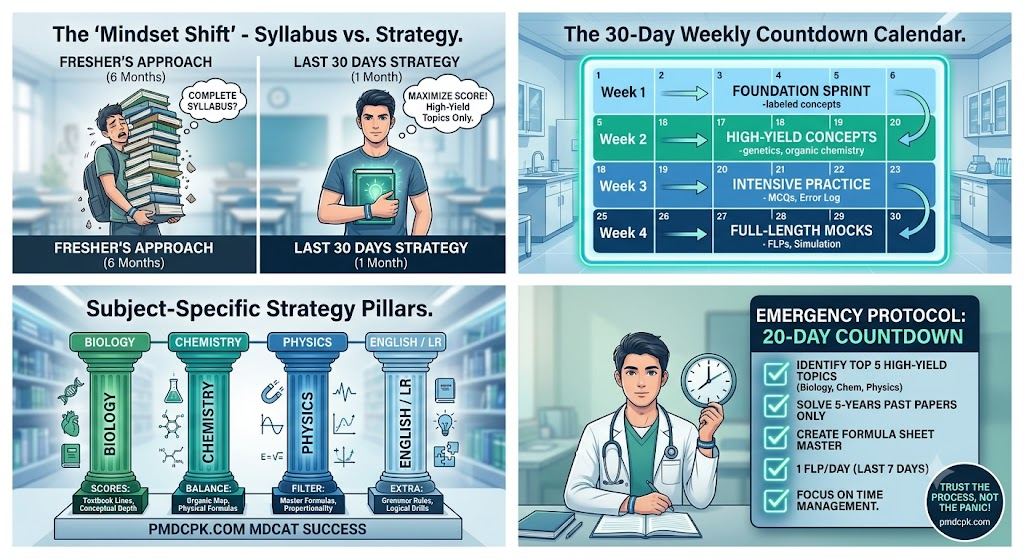
Physics (40 MCQs) — The Filter Section
Physics is typically the section that separates average students from top scorers.
- Formula Sheet: Create a master formula sheet for all chapters. Review this sheet first thing every morning and right before bed.
- Focus on Proportionalities: Most MDCAT Physics MCQs test relationships (e.g., “If the distance between two charges is doubled, what happens to the electrostatic force?”). Master how variables change in relation to each other ($F \propto 1/d^2$).
5. The A-Levels Survival Guide: Cracking MDCAT in 30 Days
If you come from an A-Levels background, you face a unique challenge: the MDCAT is heavily based on FSc provincial textbooks (like Punjab Textbook Board or Sindh Textbook Board). The syllabus content is similar, but the terminology and rote-learning style are highly different.
Step-by-Step Transition Strategy for A-Level Students
- Do Not Re-read Everything: Your conceptual foundation is likely strong. Do not start reading FSc textbooks from scratch.
- Highlight the Gaps: Focus specifically on chapters or topics that are present in FSc but were not part of your CAIE syllabus.
- Use “FSc-to-A-Level” Comparison Notes: Many online academies offer short, comparative notes highlighting the specific textbook lines you need to memorize.
- Rote Memorize Key Values: A-Levels tests concepts; FSc/MDCAT often tests direct values (e.g., exact percentages, biological sizes, or historical constant values). Memorize these directly from the local textbooks.
6. Common Mistakes to Avoid in the Final Month
1. Reading Without Testing: Spending 8 hours reading books and 0 hours solving MCQs is the fastest way to score low. Testing forces your brain to retrieve information, which builds stronger neural pathways than passive reading.
2. Neglecting English & Logical Reasoning: Students often ignore these sections thinking they are easy. However, these 20-30 marks are highly scoring and can easily push your aggregate from a 170 to a 185+.
3. Getting Stuck on a Single Hard Question: During practice, if a physics numerical takes you more than 2 minutes, skip it, mark it, and return to it during your evening error review. Do not let one difficult question ruin your study momentum.
7. The Final Count: A 20-Day Emergency Protocol
If you are reading this with only 20 or 25 days left, do not despair. You can still pass with a competitive score by utilizing Extreme Prioritization.
- Days 1 to 10: Identify the top 5 highest-yield chapters for Biology, Chemistry, and Physics. Study only those chapters and skip the rest.
- Days 11 to 17: Solve past papers from the last 5 years. Focus on understanding the pattern of questions asked by your specific provincial testing authority.
- Days 18 to 20: Work exclusively on test-taking stamina, time management, and formula revision.
You can still pull off a miracle if you trade panic for absolute, unfiltered focus. Trust your preparation, keep your daily schedule disciplined, and tackle the MDCAT one day, one chapter, and one MCQ at a time. Your medical coat is waiting for you!