

Preparing for the Medical and Dental College Admission Test (MDCAT) requires more than reading textbooks and solving multiple-choice questions. Students need a clear study plan, regular revision, consistent practice, and an honest way to measure their progress. Without tracking these activities, it is easy to spend hours studying without knowing which topics have improved and which still need attention.
A MDCAT Study Progress Tracker Template can help students organize their preparation, monitor their performance, identify weak areas, and make better use of their available time. Whether you are starting your preparation or revising before the examination, a simple tracking system can turn an overwhelming syllabus into manageable daily goals.
This guide explains how to use a study tracker effectively and provides a practical template that you can download and customize for your preparation.
What Is an MDCAT Study Progress Tracker?
An MDCAT study progress tracker is a planning tool that records your daily study activities and results. Instead of relying on memory, you maintain a written record of the subjects you studied, chapters completed, MCQs attempted, accuracy achieved, and topics requiring further revision.
For example, you might study human physiology for 90 minutes and attempt 50 Biology MCQs. If you answer 34 correctly, your accuracy is 68%. This information tells you more than the number of hours you spent studying: it also helps you decide whether you should revise the chapter, practise additional questions, or move forward.
A useful tracker should be simple enough to update every day and detailed enough to support meaningful decisions.
Download Your MDCAT Study Progress Tracker Template
You do not need to design a spreadsheet from scratch. Use this ready-made Excel template to record your study sessions, calculate MCQ accuracy, review subject-wise progress, and plan your next week.
Download the MDCAT Study Progress Tracker Template (Excel)
The workbook contains four useful sections:
- Start Here: Instructions for setting up and using the tracker.
- Daily Tracker: Records dates, subjects, chapters, study time, MCQ performance, confidence, and revision dates.
- Subject Dashboard: Summarizes study minutes, MCQs attempted, correct answers, and accuracy for each subject.
- Weekly Review: Helps you evaluate your progress and set priorities for the following week.
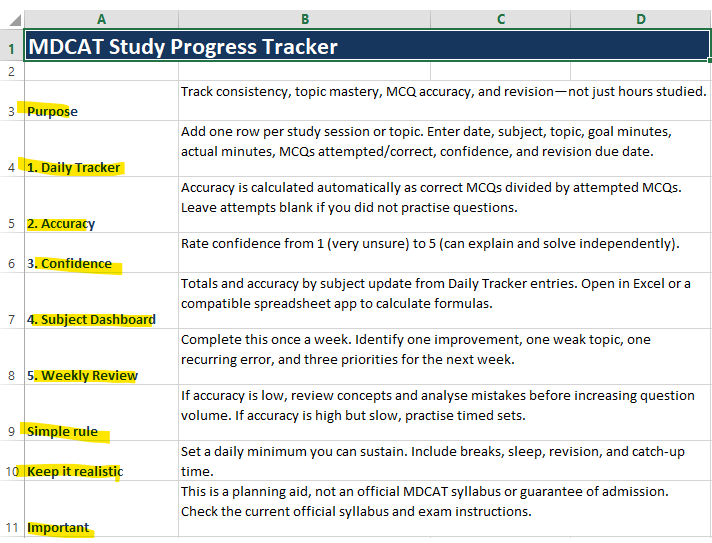
You can edit the workbook in Microsoft Excel or a compatible spreadsheet application. Add your own chapters, adjust your goals, and use the available rows to match your preparation schedule.
How to Fill In Your Daily Study Tracker
The best tracker is one you can maintain consistently. Follow these steps after each study session.
1. Record the Date and Subject
Begin by entering the date and the subject you studied. Depending on the current official MDCAT syllabus, your preparation may include Biology, Chemistry, Physics, English, and Logical Reasoning.
Record each subject separately, even when you study multiple subjects on the same day. This makes it easier to see whether your preparation is balanced.
2. Write the Exact Topic or Chapter
Avoid vague entries such as “Biology revision” or “Physics practice.” Instead, record a specific topic, such as cell division, chemical equilibrium, or work and energy.
Specific entries help you identify the chapters that consistently require extra attention.
3. Set a Realistic Study-Time Goal
Decide how many minutes you intend to spend on a topic before starting. For example, you might plan 60 minutes for concept revision and another 30 minutes for practice questions.
Enter your actual study time afterward. Comparing planned and actual time helps you understand whether your schedule is realistic.
Do not treat longer study hours as automatic evidence of better preparation. Focused learning, effective revision, and accurate question-solving are more valuable than simply sitting at a desk for extended periods.
4. Record Your MCQ Performance
Whenever you practise questions, record the number attempted and the number answered correctly.
Calculate accuracy using this formula:
MCQ Accuracy = (Correct Answers ÷ Total MCQs Attempted) × 100
For example, if you attempt 40 questions and answer 30 correctly, your accuracy is 75%.
Use accuracy as a guide rather than a final judgment of your ability. A short quiz may not represent your overall understanding, and question difficulty can vary.
5. Rate Your Confidence
After completing a topic, rate your confidence from 1 to 5:
- 1: I do not understand the topic yet.
- 2: I understand a few basic concepts.
- 3: I can solve straightforward questions but make mistakes.
- 4: I understand most concepts and usually answer correctly.
- 5: I can explain the topic and solve questions independently.
Confidence is especially useful when combined with MCQ accuracy. If your confidence is high but your results are weak, you may need to review your understanding more carefully.
6. Schedule Your Next Revision
Use the revision-date column to record when you intend to revisit a topic. Review difficult concepts sooner and return to stronger topics periodically to maintain retention.
You can adapt your revision schedule around your classes, available time, and performance. The purpose is to prevent important topics from being forgotten while you move through the syllabus.
Sample MDCAT Study Progress Tracker
Here is an example of how a few entries might look in your daily log.
| Subject | Topic | Study Time | MCQs | Correct | Accuracy |
|---|---|---|---|---|---|
| Biology | Cell Structure | 60 min | 40 | 32 | 80% |
| Chemistry | Chemical Equilibrium | 50 min | 30 | 18 | 60% |
| Physics | Work and Energy | 45 min | 25 | 20 | 80% |
| English | Vocabulary Practice | 25 min | 20 | 15 | 75% |
These figures are illustrative, not target scores or predictions of MDCAT performance.
In this example, Chemical Equilibrium deserves additional attention because its accuracy is lower than that of the other recorded topics. The student should examine incorrect answers, identify misunderstood concepts, and practise similar questions before deciding whether the topic is ready for revision only.
Read More: NUMS or PMDC MDCAT 2026: Differences
This is how a tracker turns raw numbers into a useful study decision.
How to Use the Weekly Review Sheet
Daily records show what happened during individual sessions. Weekly reviews help you understand the bigger picture.
At the end of each week, answer five questions:
1. What did I complete?
List the chapters revised, concepts learned, and practice sessions completed. Compare these achievements with your original goals.
2. Which topics caused the most mistakes?
Look beyond the total number of incorrect answers. Determine whether errors came from weak concepts, forgotten facts, calculation mistakes, confusing question wording, or poor time management.
3. Which subjects need more attention?
Review your subject dashboard and identify areas that deserve extra practice. Avoid making decisions based on one unusually good or bad quiz.
4. What should I change next week?
If you repeatedly fail to finish planned chapters, reduce the size of your daily goals. If you understand concepts but struggle with timed questions, include more timed practice.
5. Have I allowed enough time for rest and revision?
A realistic timetable includes breaks, sleep, and catch-up periods. Leaving some flexibility in your schedule makes it easier to recover from an unexpectedly busy day without abandoning your entire plan.
Write down three priorities for the coming week rather than creating an excessively long list of tasks.
Five Mistakes to Avoid When Tracking MDCAT Preparation
Tracking Hours Instead of Understanding
Study time matters, but it does not prove that you have mastered a topic. Track your practice results and ability to explain concepts alongside the time spent studying.
Ignoring Incorrect MCQs
Simply checking your score wastes an opportunity to learn. Review wrong answers and note why each mistake occurred. Reattempt similar questions after revising the relevant concept.
Setting Unrealistic Daily Targets
A timetable that assumes every day will be perfect is difficult to maintain. Set achievable minimum goals and keep additional tasks for days when you have more time.
Repeating Strong Topics and Avoiding Weak Ones
Students sometimes revisit familiar chapters because they feel comfortable. Use your tracker to identify neglected or difficult topics and give them appropriate attention.
Changing the Plan After Every Test
One poor practice result does not necessarily mean your entire strategy is wrong. Look for repeated patterns across several sessions before making major changes.
Frequently Asked Questions
Is the MDCAT Study Progress Tracker free?
Yes. The downloadable Excel workbook provided in this guide can be used as a personal study-planning template. You can customize its subjects, topics, and goals to suit your needs.
Can I use the tracker on my mobile phone?
You can open the spreadsheet in a compatible mobile spreadsheet application. However, editing and viewing the full dashboard may be more convenient on a computer.
How many hours should I study daily for MDCAT?
There is no single ideal number for every student. Your daily study time should depend on your current preparation, school or college commitments, remaining syllabus, and personal learning needs. Consistent, focused sessions are more useful than following an unrealistic timetable.
Should I record every MCQ I attempt?
You do not need to record every individual question. Recording the number attempted, number correct, topic, and recurring mistake patterns is usually sufficient for tracking progress. Keep separate notes for particularly difficult questions if they need further review.
When should I start using the tracker?
Start as soon as you begin preparing. If you have already started studying, begin with your current progress and record previous achievements only when you have reliable information. There is no need to reconstruct every past study session.
Final Thoughts
Effective MDCAT preparation is not only about completing chapters; it is about understanding what you know, recognizing what needs improvement, and adjusting your study plan accordingly.
A well-maintained study progress tracker gives you a practical way to monitor daily effort, evaluate MCQ performance, organize revision, and set realistic weekly priorities. It can also help reduce the uncertainty that comes with preparing for a competitive entrance examination.
Download the MDCAT Study Progress Tracker Template, customize it to your routine, and update it consistently. Use your results to guide your next steps, check the latest official MDCAT syllabus and examination instructions, and remember that steady improvement matters more than a perfect-looking timetable.