
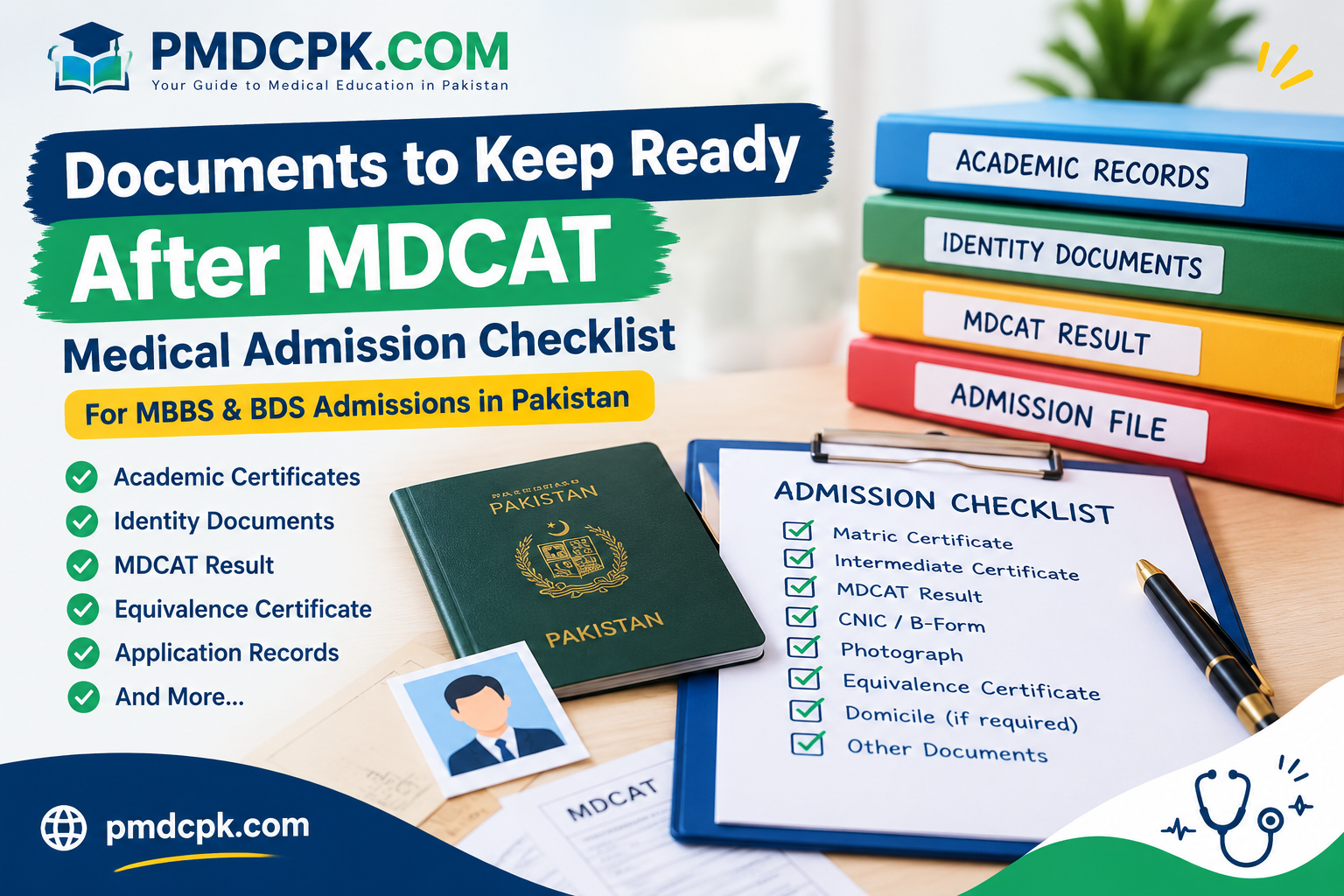
Have you appeared in the MDCAT and are now preparing to apply for MBBS or BDS admission? Keeping your documents organized before the admission process begins can save time, reduce application mistakes, and help you respond quickly when a medical college or admitting university requests additional information.
Many students focus on their MDCAT scores and merit positions but delay preparing their academic records, identity documents, photographs, and other supporting papers. This can create unnecessary stress when admission applications open or a selection list is announced.
In this guide, you will learn which documents to prepare after MDCAT, which students may need additional certificates, and how to organize your admission file before applying to medical and dental colleges in Pakistan.
Important: Document requirements vary by admitting university, province, college, and admission category. Treat this as a preparation checklist, not a universal official list. Always follow the latest admission advertisement, prospectus, and instructions issued by the relevant authority.
1. Essential Documents to Prepare After MDCAT
Start by collecting the following documents. Some may be required during online application, while others may be requested later for verification or final admission.
Matriculation (SSC) Certificate or Result Card
Keep your Matriculation certificate or official result card ready. Medical admission authorities may use it to verify your educational record and personal details.
Check that your name, father’s name, date of birth, examination board, and marks match the information entered in your admission application. If you have a corrected certificate or updated educational record, keep the appropriate official document available.
Intermediate (HSSC/FSc) Certificate or Result Card
Your Intermediate record is an important part of your medical admission file. Prepare your FSc Pre-Medical or equivalent HSSC certificate and result card, including the relevant marks details.
If your final result has not been announced, check whether the admitting university accepts result-awaiting candidates and what provisional evidence it requires.
Do not assume that a college will accept a screenshot of an online result. Use the document format specified in the current admission instructions.
MDCAT Result Details
Keep your MDCAT result card or official result record accessible. You may need your examination details while completing an admission form or checking eligibility.
Verify your name, roll number, examination year, and score. If the admitting authority provides a result verification or correction procedure, follow its official instructions if you identify a discrepancy.
Also check whether your intended college or admitting university requires a particular entrance-test result for the relevant admission session.
CNIC, B-Form, or Other Accepted Identity Document
Prepare the identity document accepted for your age and admission category. Depending on the current instructions, this may include:
- CNIC for eligible candidates aged 18 or older.
- B-Form or Juvenile Card for younger candidates, where accepted.
- NICOP or passport for eligible overseas or foreign applicants.
The exact accepted documents can differ between admission authorities. Check the latest prospectus before submitting your application.
Make sure the identity details are readable and consistent with your academic records.
Recent Passport-Size Photograph
Keep a recent passport-size photograph in the format required by the admission portal. Some universities specify a particular background, image size, file format, or maximum upload size.
Use a clear photograph that meets the official requirements. Avoid uploading a cropped social-media image or an unclear selfie when a formal photograph is required.
Keep a digital copy available for online applications and printed copies if the university requests them.
2. Additional Documents Some Applicants May Need
Not every student needs every document in this section. Your requirements depend on your educational background, nationality, and the admission category for which you apply.
| Document | Who may need it? |
|---|---|
| IBCC equivalence certificate | Applicants with qualifications such as O Levels, A Levels, or other foreign credentials |
| Parent or guardian’s identity document | Applicants whose admitting university requires parent or guardian identification |
| Domicile certificate | Candidates applying under a category for which domicile is required |
| Migration or NOC certificate | Students changing boards or institutions when the relevant authority requires it |
| Foreign qualification transcripts | Applicants whose previous education was completed under a foreign examination system |
| Category-specific supporting documents | Candidates applying under an officially announced reserved or special seat category |
IBCC Equivalence Certificate
Students with foreign educational qualifications may need an equivalence certificate issued by the Inter Boards Coordination Commission (IBCC).
This document establishes the Pakistani educational equivalence of the relevant qualification. Check whether your admitting university requires equivalence for Matriculation, Intermediate, or both levels.
If you have not obtained the required certificate, review the official IBCC process early rather than waiting until the admission deadline.
Domicile Certificate
Some admission categories may require a domicile certificate or other proof of eligibility for a particular region.
Do not assume that the same domicile rules apply to every province, university, or seat category. Read the relevant prospectus and prepare the certificate only according to the requirements that apply to your application.
Migration Certificate or NOC
If you changed your educational board or institution, a migration certificate or No Objection Certificate (NOC) may be necessary in certain circumstances.
Ask your previous board, current institution, or admitting university whether this document is required. Preparing it in advance can help avoid delays if verification becomes necessary.
3. Documents to Keep Ready for Online Applications
Online admission systems may require you to enter information and upload documents before your application can be submitted.
Create a separate folder on your computer containing clear digital copies of your:
- Academic certificates and result cards.
- Accepted identity document.
- MDCAT result record.
- Recent photograph.
- Equivalence certificate, if applicable.
- Other documents specifically requested in the admission notice.
Before uploading anything, check the portal’s permitted file formats, size limits, and image requirements. A document that is correct but uploaded in an unsupported format may cause an avoidable application problem.
Never share your portal password, one-time verification code, or sensitive identity documents with unofficial agents.
4. Prepare Your Documents for Verification
Submitting an online application does not always complete the admission process. A university may later request original documents, attested copies, additional evidence, or in-person verification.
Prepare a physical folder with your original documents and a separate set of photocopies. Keep the originals safe and take them to an institution only when its official instructions require them.
Use this simple organization method:
- Place academic records together in chronological order.
- Keep identity documents in a separate section.
- Store MDCAT information and application records together.
- Add any required equivalence, domicile, or category-specific certificates.
- Keep copies of submitted forms, fee receipts, and admission correspondence.
Do not send original certificates by post or surrender them permanently unless the responsible authority provides clear, official instructions.
5. Keep Application and Fee Records
Document preparation should also include records related to your application. These may help you resolve questions about submission or payment.
Keep copies of the following whenever applicable:
- Submitted online admission application.
- Application or tracking number.
- Fee challan or payment confirmation.
- Application submission confirmation.
- Relevant emails, notices, and official correspondence.
After submitting an application, log in to the official portal and check its status. If payment is deducted but the portal does not update, follow the official support procedure rather than paying again without checking the transaction.
6. Common Document Mistakes to Avoid
Students can reduce admission-related problems by checking their paperwork before submission.
Name or date-of-birth mismatch: Compare your identity document with your academic records. If there is an error, ask the relevant issuing authority how to correct it.
Unclear scans: Make sure every uploaded page is readable and contains all required information. Do not cut off certificate numbers, stamps, or other important details.
Expired or incorrect documents: Check validity where relevant, especially for identity and supporting documents.
Missing equivalence: Foreign qualification holders should verify the applicable equivalence requirements early.
Wrong file format: Follow the portal’s specific instructions for file type, size, and photograph dimensions.
Unverified advice: Do not rely exclusively on social-media posts or unofficial groups for admission requirements. Confirm important details through the relevant admitting university or authority.
Read More About: Career Options After MDCAT Failure
7. Final Medical Admission Document Checklist
Use this checklist to track your preparation. Tick each item only after confirming that it is available and correct.
- Matriculation certificate or result card
- Intermediate/FSc certificate or result card
- MDCAT result record
- Accepted CNIC, B-Form, Juvenile Card, NICOP, or passport, as applicable
- Recent photograph meeting portal requirements
- IBCC equivalence certificate, if required
- Domicile certificate, if required
- Migration certificate or NOC, if required
- Parent or guardian identity document, if requested
- Other category-specific supporting documents, if applicable
- Clear digital copies in the permitted formats
- Application confirmation and fee records, when available
8. Where to Verify Official Requirements
Before applying, consult the latest prospectus and admission notices published by the admitting university or relevant authority. Requirements may change between admission sessions, so an older checklist may not reflect the current process.
For example, the National University of Medical Sciences (NUMS) publishes admission information and document instructions for its constituent, affiliated, and military-administered medical and dental colleges. The University of Health Sciences (UHS) also publishes admission policies and notices for relevant medical and dental admissions.
You can start with their official websites:
- National University of Medical Sciences (NUMS)
- University of Health Sciences (UHS)
- Inter Boards Coordination Commission (IBCC)
- Pakistan Medical and Dental Council (PMDC)
Always use the instructions applicable to your intended college, admission category, and session rather than assuming one university’s requirements apply everywhere.
Conclusion
Preparing your documents after MDCAT is a practical step toward a smoother MBBS or BDS admission process. Start with your academic certificates, identity document, MDCAT result, and photograph. Then check whether your educational background or admission category requires additional certificates, such as IBCC equivalence or domicile.
Keep digital files organized, retain copies of application and payment records, and verify every requirement against the latest official prospectus. Good preparation will not guarantee admission, but it can help you avoid preventable paperwork errors and focus on the next stage of your medical education journey.