
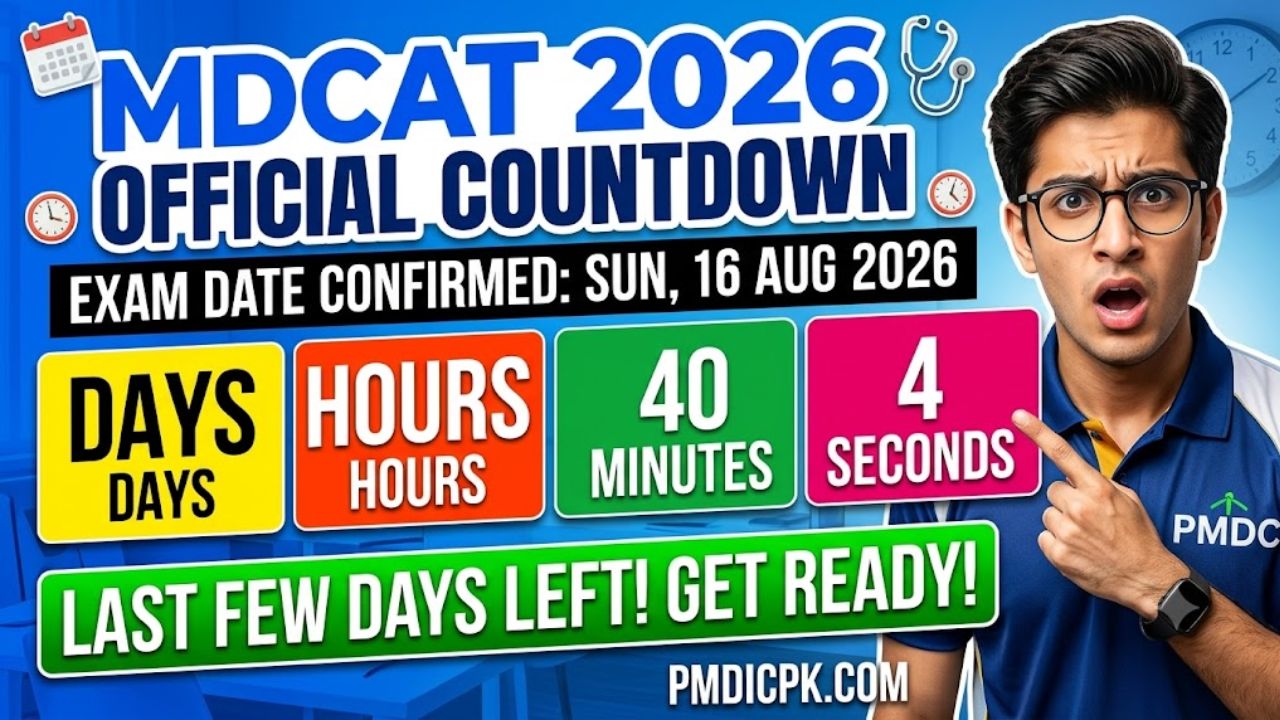
The wait is officially over for hundreds of thousands of medical aspirants across Pakistan. The Pakistan Medical and Dental Council (PMDC) has confirmed the definitive schedule for the Medical and Dental College Admission Test (MDCAT) 2026.
For every pre-medical student, the MDCAT is not just another exam—it is the ultimate gateway to your dream of wearing a white coat. With nearly 200,000 students competing for a limited number of public sector MBBS and BDS seats, clarity and accurate planning are your biggest assets. Gaps in information, social media rumors, and shifting registration deadlines only add to pre-exam anxiety.
This original, comprehensive guide serves as your single source of truth for MDCAT 2026. We break down the official timeline, regional conducting universities, paper blueprint, and actionable strategies to ensure your preparation matches the high stakes of this high-pressure exam.
Official MDCAT 2026 Schedule & Crucial Timings
Following the official public notice issued by the PMDC, the MDCAT 2026 will take place simultaneously nationwide on a single day. This strict, single-paper policy is designed by the council to ensure maximum transparency and minimize any chances of paper leaks.
Mark your calendars with the verified official timeline:
- Official Exam Date: Sunday, 16 August 2026.
- Reporting Time: 8:00 AM PST.
- Paper Start Time: 10:00 AM PST sharp.
- Total Duration: 180 minutes (3 hours).
Crucial Reminder: While the 8:00 AM reporting and 10:00 AM paper-start pattern follows the historical PMDC guidelines, always double-check your issued roll-number slip for exact venue-specific instructions and gate closing times.
Province-Wise Test Conducting Bodies and Portals
While the PMDC acts as the central regulating council, the physical administration of the exam is decentralized across regional public-sector universities. You must track announcements on the official portal assigned to your respective province or region.
| Province / Region | Designated Conducting Body | Official Portal |
| Punjab | University of Health Sciences (UHS) Lahore | uhs.edu.pk |
| Sindh | Dow University of Health Sciences (DUHS) Karachi | duhs.edu.pk |
| Khyber Pakhtunkhwa (KPK) | Khyber Medical University (KMU) Peshawar | kmu.edu.pk |
| Balochistan | Bolan Medical College (BMC) Quetta | bmc.edu.pk |
| Azad Jammu & Kashmir (AJK) | Educational Testing and Evaluation Agency (ETEA) | etea.edu.pk |
| Federal Capital / NUMS | National University of Medical Sciences (NUMS) Rawalpindi | numspak.edu.pk |
Note: While NUMS conducts its own separate institutional MDCAT for its specific military-affiliated colleges, all provincial public university seats rely entirely on the central PMDC MDCAT score.
MDCAT 2026 Exam Countdown
Here’s a live countdown to the big day:
Understanding the MDCAT 2026 Exam Pattern
Achieving a top score requires a deep understanding of the structure of the paper. PMDC has kept the structure predictable, meaning students can build a highly targeted test-taking strategy.
- Total Number of Questions: 180 Multiple Choice Questions (MCQs).
- Total Marks: 180 Marks.
- Negative Marking: None. There is absolutely no penalty for incorrect answers, meaning you must attempt every single question on the paper.
- Testing Mode: Paper-based conventional format (OMR bubble sheets).
Subject-Wise Weightage Breakdown
The test assesses core conceptual clarity across five major areas:
- Biology (68 MCQs / 37.8%): Focuses heavily on human physiology, cell biology, genetics, and ecology.
- Chemistry (54 MCQs / 30%): Divided between organic pathways, inorganic trends, and physical chemistry concepts.
- Physics (44 MCQs / 24.4%): Emphasizes formula applications, conceptual laws, and numerical problem-solving.
- English (14 MCQs / 7.8%): Tests basic vocabulary, grammatical corrections, and sentence completions.
- Logical Reasoning (6 MCQs / 3.3%): Assesses critical thinking, pattern recognition, and spatial logic.
Strategic Blueprint: Turning the Countdown into a Top Score
A countdown timer ticking down can build unnecessary anxiety if you do not have a structural plan. To transition from passive cramming to high-yield execution, follow this phased study strategy:
Phase 1: Text-Book Mastering (First Half of Prep)
- Stick to Your Textbook: Your provincial textbook is your primary authority. Read between the lines, memorize exceptions, and annotate your books with tricky points.
- Conceptual Clarity: The modern MDCAT leans heavily toward analytical, application-based questions. If you memorize formulas without understanding how they change when variables shift, the physics and chemistry sections will trip you up.
Phase 2: High-Volume Question Practice (Mid-Way Prep)
- Leverage Past Papers: Solve every available past paper from your respective conducting university from the last five years. This helps decode the specific phrasing styles used by different paper setters.
- Analyze Errors: Do not just check your score. Keep an “Error Log Book.” Write down every MCQ you get wrong, why you got it wrong, and the correct underlying concept.
Phase 3: Simulated Exam Conditioning (Final 30 Days)
- Time-Bound Mock Tests: Sit down at exactly 10:00 AM on weekends and solve a full-length 180-MCQ paper. Limit your time strictly to 180 minutes to train your brain to perform under real constraints.
- OMR Bubble Sheet Training: Practice physically filling out bubble sheets. Many students lose marks simply because they accidentally skipped a line or misaligned their bubble markings on the real exam.
Also Read More About: PMDC MDCAT 2026 International Students Guide: Riyadh Centre
5 Critical Mistakes to Avoid on MDCAT Day
- Leaving Bubbles Blank: Since there is absolutely no negative marking, leaving a question blank is a guaranteed loss of a mark. If you run out of time, make an educated guess for all remaining questions.
- Poor Time Allocation: Spending five minutes wrestling with a complex Physics numerical will leave you with no time for simple Biology questions. If a question takes more than 45 seconds, mark a tentative guess, circle it on your question booklet, and move forward.
- Ignoring the Domicile Requirement: PMDC rules dictate that your Matric, Intermediate, and Domicile certificates must align with the regulations of the province where you are appearing for the test.
- Misreading Questions: Cognitive fog leads to reading errors, misinterpreting words like “EXCEPT”, “NOT”, or “INCORRECT” in questions, costing you easy marks. Read the question stem twice before looking at the options.
- Neglecting Sleep Hygiene: Pulling an all-nighter right before August 16 is a recipe for mental fatigue. Prioritize a solid 7 to 8 hours of sleep before the big day to keep your mind sharp and alert.
Summary & Next Steps
The MDCAT 2026 date is fixed for Sunday, 16 August 2026. The criteria are clear, the breakdown is stable, and the timeline is set. What matters now is consistency. Treat every day on your countdown clock as an opportunity to fix a weak concept or master another chapter. Trust your preparation, practice under timed conditions, and approach the exam systematically. Your medical career starts with the work you put in today.