
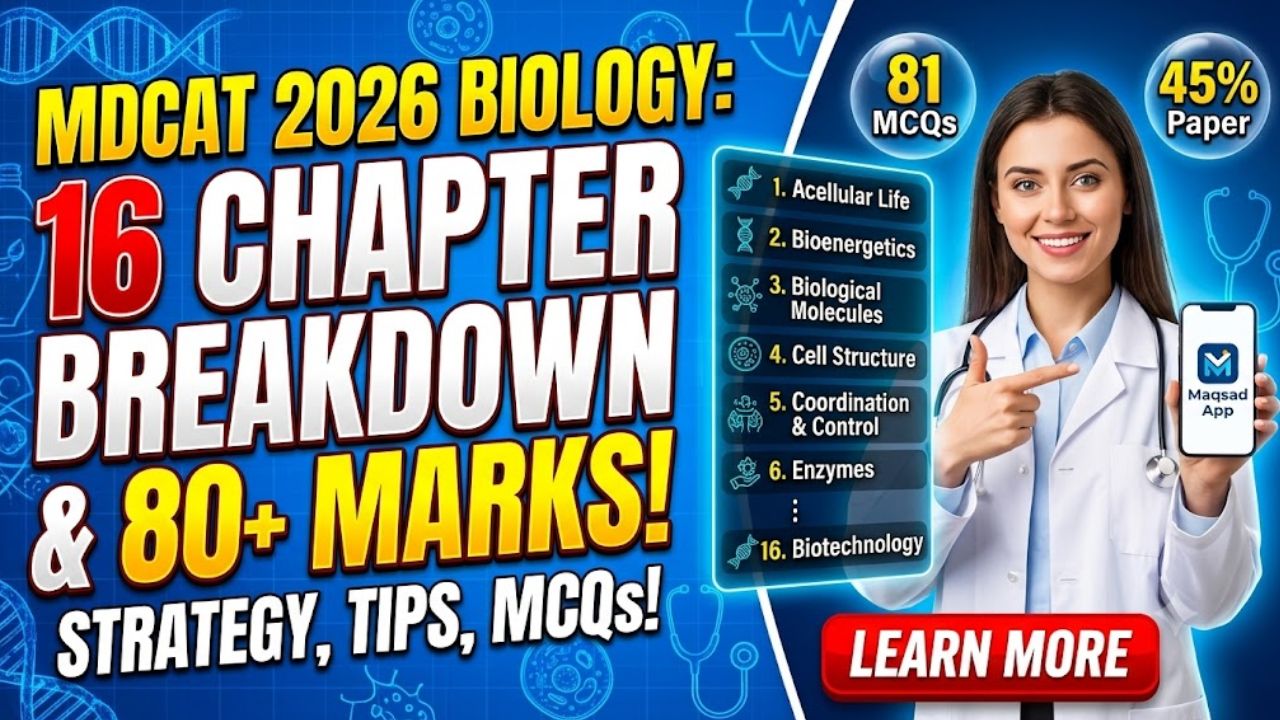
For medical aspirants across Pakistan, the Medical and Dental College Admission Test (MDCAT) is the ultimate gateway to securing a seat in a prestigious MBBS or BDS program. Among all the subjects tested, Biology is the undisputed king. Accounting for a massive 45% of the total weightage with exactly 81 MCQs, your performance in Biology can single-handedly make or break your medical aggregate.
While many students treat Biology as a subject of simple memorization, the Pakistan Medical and Dental Council (PMDC) designs questions to evaluate core conceptual depth and analytical application. Rote learning textbook lines without mastering the official learning objectives is the fastest way to hit a ceiling.
PMDC MDCAT Biology Weightage at a Glance
Before diving into individual chapters, you must understand the structural scale of the Biology portion. To achieve AdSense-compliant, premium preparation, align your daily clock with the official blueprint:
- Total Biology MCQs: 81 Questions
- Total Percentage Weightage: 45% of the entire MDCAT paper
- Testing Philosophy: 15% Easy (Direct book lines), 70% Moderate (Conceptual application), and 15% Difficult (High-order analytical integration).
All 16 Biology Chapters & Official Learning Outcomes
The PMDC constructs every question strictly around specific learning objectives. If a concept falls outside these objectives, you do not need to waste valuable hours on it. Below is the complete curriculum blueprint you must follow.
1. Acellular Life (Viruses)
This chapter tests your understanding of life forms that lack cellular machinery.
- Learning Outcomes:
- Classify viruses on the basis of their structural design, number of genetic strands, associated diseases, and specific host organisms.
- Identify specific symptoms, precise modes of transmission, and the underlying cause of viral conditions like AIDS.
2. Bioenergetics
A highly conceptual chapter that requires mapping chemical pathways and energy transformations.
- Learning Outcomes:
- Outline the metabolic cellular respiration pathways of proteins and fats, and correlate these mechanisms directly with the breakdown of glucose.
3. Biological Molecules
The chemical foundation of living organisms. This chapter carries significant weightage due to structural details.
- Learning Outcomes:
- Define and accurately classify different classes of biological molecules.
- Discuss the biochemical importance of macromolecules in living systems.
- Describe the vital properties of water (polarity, hydrolysis, specific heat capacity, behavior as a solvent/reagent, density variations, cohesion, and ionization).
- Discuss carbohydrates thoroughly: Monosaccharides (glucose), Oligosaccharides (cane sugar, sucrose, lactose), and Polysaccharides (starches, cellulose, glycogen).
- Describe proteins, focusing on amino acid properties and structural levels (primary, secondary, tertiary, quaternary).
- Describe lipids: Phospholipids, triglycerides, alcohols, and esters (acylglycerol).
- Give a clear account of the structural variations and functional duties of RNA.
- Discuss conjugated molecules, including glycolipids and glycoproteins.
- Explain the double-helical structural model of DNA proposed by Watson and Crick.
- Define a gene as a specific sequence of nucleotides making up a part of DNA that codes for a polypeptide.
Also Read More About: PMDC MDCAT Syllabus 2026: Paper Pattern
4. Cell Structure & Function
Moving from molecules to structural units, this chapter focuses on comparative anatomy at a microscopic level.
- Learning Outcomes:
- Compare the microscopic structure of typical animal and plant cells.
- Compare and contrast the organizational structure of prokaryotic cells with eukaryotic cells.
- Outline the precise structure and function of essential organelles: Nucleus, Endoplasmic Reticulum, Golgi Apparatus, and Mitochondria.
- Describe the structural composition, chemical nature, and cellular function of chromosomes.
5. Coordination & Control
This module bridges the nervous system and hormonal regulation. Expect application-based scenario questions here.
- Learning Outcomes:
- Recognize biological receptors as biological transducers sensitive to diverse external and internal stimuli.
- Explain the anatomy of a typical neuron (cell body, dendrites, axon, and myelin sheath).
- Define the electrochemical nature of a nerve impulse.
- Classify different types of physiological reflexes.
- Briefly explain the functions of the individual components of a reflex arc.
- Discuss the anatomy of the human brain (brain stem, midbrain, cerebellum, cerebrum) and describe the explicit functions of each part.
6. Enzymes
A short but highly scoring chapter centered on chemical kinetics.
- Learning Outcomes:
- Describe the unique distinguishing characteristics of enzymes.
- Explain the core mechanisms of enzyme action (Lock-and-Key vs. Induced-Fit models).
- Describe how external factors alter enzyme activity (temperature thresholds, optimal pH, and substrate/enzyme concentration).
- Describe enzyme inhibitors (competitive vs. non-competitive).
7. Evolution
- Learning Outcomes:
- Explain the origin of life according to foundational evolutionary concepts.
- Describe the theory of inheritance of acquired characters proposed by Lamarck, and identify its flaws.
- Explain the theory of natural selection formulated by Darwin.
8. Reproduction
- Learning Outcomes:
- Describe the anatomy and functions of the male and female reproductive systems along with the regulatory hormones (FSH, LH, estrogen, progesterone, testosterone).
- Describe the human menstrual cycle, emphasizing the exact hormonal feedback loops.
- List common sexually transmitted diseases (STDs) alongside their causative pathogens and primary symptoms.
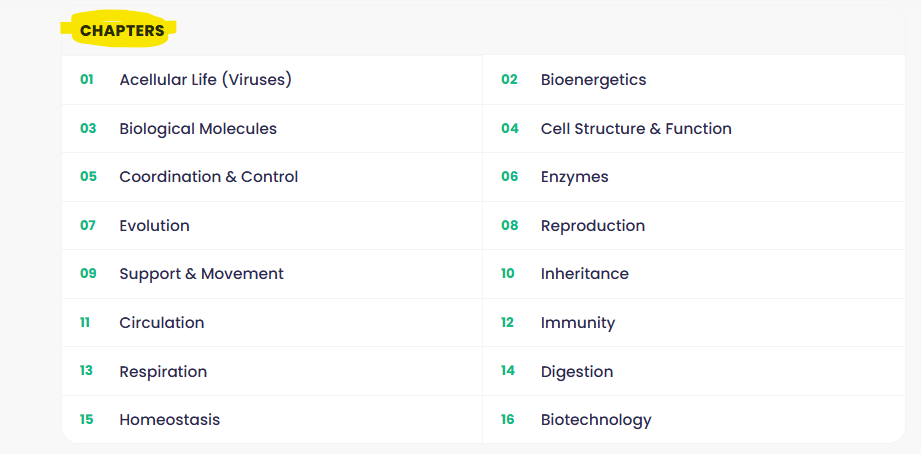
9. Support & Movement
- Learning Outcomes:
- Describe the histology of cartilage, muscle, and bone tissues.
- Explain the structural characteristics and skeletal functions of cartilage and bone.
- Compare the physiological properties of smooth, cardiac, and skeletal muscles.
- Explain the microscopic ultra-structure of skeletal muscle fibers (sarcomeres, actin, myosin).
- Describe the step-by-step sliding filament mechanism of skeletal muscle contraction.
- Classify structural and functional joints.
- Define arthritis and distinguish its primary forms.
10. Inheritance
One of the most challenging chapters, featuring complex genetic crosses and probability calculations.
- Learning Outcomes:
- Associate inheritance patterns with classical Mendelian laws.
- Explain the Law of Independent Assortment using dihybrid crosses.
- Describe the terms gene linkage and crossing over.
- Explain how gene linkage limits independent assortment, and how crossing over modifies progeny ratios.
- Describe sex-linkage concepts and traits.
- Analyze the genetic inheritance patterns of hemophilia and color blindness.
11. Circulation
- Learning Outcomes:
- Discuss the gross internal structure of the human heart.
- Describe the distinct phases of the cardiac cycle (systole and diastole).
- Contrast the structural differences and localized functions of arteries, veins, and capillaries.
- Describe the human lymphatic system, including lymph nodes, vessels, and specialized lymphoid organs.
12. Immunity
- Learning Outcomes:
- Define and discuss the functions, lines of defense, and overarching importance of specific defense mechanisms (B and T lymphocytes, antibodies).
13. Respiration
- Learning Outcomes:
- Discuss the physiological functions of the primary components of the human respiratory tract.
- Discuss the mechanics of gas exchange ($O_2$ and $CO_2$) within human alveoli.
- Discuss the localized pathological effects of smoking on the respiratory system.
14. Digestion
- Learning Outcomes:
- Describe the mechanical and chemical parts of the human digestive system.
- Explain the digestive functions of the primary organs, associated structures, and specialized accessory glands (liver, pancreas).
15. Homeostasis
A massive chapter that interlinks multiple human organ systems.
- Learning Outcomes:
- Explain the organs of the urinary system, describing kidney structure and its relation to function.
- Explain glomerular filtration, selective reabsorption, and tubular secretion.
- Justify how the kidney acts simultaneously as an organ of excretion and osmoregulation.
- Compare the functional dynamics of the two major renal capillary beds (glomerular vs. peritubular capillaries).
- Explain the causes and clinical treatments of kidney stones and renal failure.
- Describe the necessity of thermoregulation in endotherms.
- List various nitrogenous waste compounds excreted by different animal groups.
16. Biotechnology
- Learning Outcomes:
- Describe how biotechnologists combat global health challenges by manufacturing modern vaccines.
- State the role of biotechnology in rapid disease diagnosis (DNA/RNA probes, monoclonal antibodies).
- Describe commercial products obtained through genetic engineering for metabolic disease treatment.
Comprehensive Summary Table: MDCAT Biology High-Yield Mapping
| Chapter Category | Key Focus Areas | Typical Question Style | Expected Difficulty |
| Cellular & Molecular | Chapters 3, 4, 6 & 16 | Structural formulas, organelle functions, enzyme inhibition curves. | Moderate to High |
| Human Physiology | Chapters 5, 11, 12, 13, 14 & 15 | Hormonal feedback loops, cardiac cycles, filtration pathways, reflex arcs. | Moderate |
| Continuity & Genetics | Chapters 1, 7, 8, 9 & 10 | Mendelian ratios, linkage mapping, viral replication steps, sarcomere changes. | High |
3 Critical Pitfalls to Avoid in MDCAT Biology Preparation
Many top-tier students score poorly in Biology because they treat it identically to intermediate board exams. To secure your seat, avoid these systemic mistakes:
The Passive Reading Trap: Reading a chapter five times gives you an illusion of competence. However, recognition is not the same as active recall. If you do not test yourself under timed conditions, you will freeze when presented with closely matching distractors on the OMR sheet.
- Ignoring Inter-Provincial Differences: While the PMDC syllabus is standardized, your local textbook might frame a concept slightly differently than other boards. Federal and Punjab textbooks are highly recommended resources to reference whenever a conceptual contradiction occurs.
- Skipping the Learning Outcomes: Spending hours memorizing specific scientific names of minor plants or irrelevant evolutionary lineages is a waste of time. If a detail does not directly support an official learning outcome listed above, skip it.
- Mismanaging the 15% Analytical Bracket: Genetic crosses (Chapter 10) and Bioenergetics pathways (Chapter 2) contain questions that require calculations. Treat these sections with the same logical rigor you apply to Physics numericals.
Actionable Strategy: How to Prepare with High-Efficiency Tools
To avoid the “Low Value Content” trap and streamline your preparation, use advanced platforms like the Maqsad App. Their ecosystem is custom-built around the 16 PMDC chapters:
- Watch Objective-Driven Lectures: Instead of watching open-ended videos, use lectures that map directly onto the specific PMDC learning outcomes.
- Solve Chapter-Wise MCQs: Immediately after completing a chapter, practice at least 100-150 objective questions to solidify your active recall.
- Analyze Mistake Logs: Keep a dedicated notebook for questions you answer incorrectly during mock tests. Reviewing your mistakes is twice as valuable as repeating questions you already know how to solve.
Final Thoughts
Biology dictates the pace of your MDCAT exam. Because it accounts for 45% of your paper, completing these 81 MCQs quickly and accurately buys you critical surplus time to solve challenging physics calculations and chemistry stoichiometry problems later in the session. Master the official learning outcomes, prioritize active recall, and approach every chapter with analytical precision to unlock a 180+ score. For more Latest Update About pmdc visiti offical page.