
For medical aspirants in Pakistan, the Medical and Dental College Admission Test (MDCAT) is the ultimate hurdle between intermediate education and a prestigious medical college seat. Among the subjects tested, Physics often creates the highest level of anxiety. While Biology demands heavy memorization and Chemistry requires conceptual understanding and numerical skills, Physics often presents a unique challenge—the need to merge abstract concepts with demanding mathematical execution under extreme time pressure.
Accounting for 20% of the total paper with exactly 36 MCQs, your performance in Physics can significantly impact your aggregate. Many students mistakenly treat Physics as a subject of rote-memorization, which is a major pitfall. The Pakistan Medical and Dental Council (PMDC) national syllabus is designed to evaluate your ability to apply core physical principles to new scenarios.
PMDC MDCAT Physics Syllabus 2026: The Strategic Scale
To succeed, you must first understand the battlefield. The PMDC maintains a strict difficulty distribution designed to filter candidates based on true understanding. Your preparation cannot treat every subject or difficulty bracket equally.
- Total Physics MCQs: 36 (Out of 180)
- Weightage: 20% of the total exam
- Format: Paper-based OMR answer sheet, no negative marking ($+1 / 0$).
- Difficulty Spectrum: 15% Easy (Direct textbook lines/definitions), 70% Moderate (conceptual application/formula rearrangement), 15% Difficult (High-order integration & complex, multi-step numericals).
This difficulty mix means you must prioritize the 70% moderate bracket. Securing a seat requires flawless execution in this segment. You can use platforms like Maqsad, where Sir Wasiq and the faculty break down these specific 16 chapters using objective-centric video lectures and over 15,000 chapter-wise practice MCQs to match this pacing.
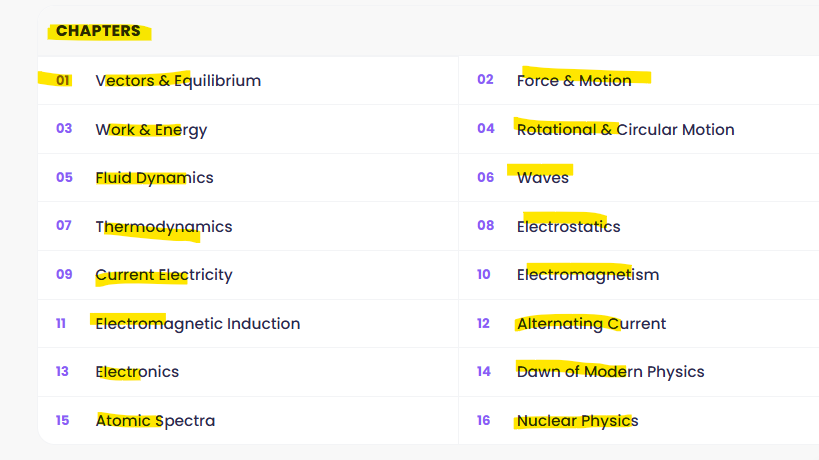
All 16 Physics Chapters & Official Learning Outcomes
The exam is built strictly around specific learning outcomes defined by the PMDC. You cannot afford to spend days on concepts outside this official list. Below is the full curriculum breakdown you must follow to avoid “Low Value” preparation.
1. Vectors & Equilibrium
This is a calculation-heavy foundational chapter. Expect MCQs testing vector addition via components and scalar/vector products.
- Learning Outcomes:
- Determine the sum of vectors using perpendicular components.
- Describe Scalar Product (dot product) of two vectors in terms of the angle between them ($A \cdot B = AB\cos\theta$).
- Describe Vector product (cross product) of two vectors in terms of the angle between them ($A \times B = AB\sin\theta \cdot n$).
2. Force & Motion
A massive, foundational block. Prioritize projectile motion and collision dynamics.
- Learning Outcomes:
- Describe displacement, average velocity, and interpret displacement-time graphs.
- Describe and distinguish between uniform and variable acceleration.
- Explain projectile motion as 2D motion in a vertical plane in the absence of air resistance.
- Explain constant horizontal velocity ($V_h$) and vertical acceleration ($g$).
- Differentiate characteristics of horizontal and vertical motion.
- Evaluate max height, range, time of flight, and maximum angle using equations of motion.
- Apply Newton’s Laws to motion in varied contexts.
- Describe Newton’s second law as the rate of change of momentum ($F = dp/dt$).
- Correlate Newton’s third law and conservation of momentum.
- Solve elastic and inelastic collision problems in 1D using momentum conservation and identify that relative speed of approach equals relative speed of separation for perfectly elastic collisions.
3. Work & Energy
Expect scenario questions testing the interconversion of kinetic and potential energy.
- Learning Outcomes:
- Describe the concept of work ($W = F \cdot d = Fd\cos\theta$) in terms of force and displacement.
- Explain energy, kinetic energy, and potential/gravitational potential energy.
- Describe gravitational potential energy measurement from a reference level (can be positive or negative).
- Express power as the scalar product of force and velocity ($P = F \cdot v = Fv\cos\theta$).
- Explain that work done against friction is dissipated as heat in the environment and discuss implications of energy losses in practical devices.
4. Rotational & Circular Motion
- Learning Outcomes:
- Define angular displacement, express angular displacement in radians, and define revolution, degree, and radian.
- Describe angular velocity.
- Find the relationship between linear and angular variables ($v = r\omega$, $a = r\alpha$).
5. Fluid Dynamics
A high-yielding chapter. Prioritize terminal velocity and Bernoulli’s principle application.
- Learning Outcomes:
- Describe terminal velocity and fluid drag.
- Define steady (laminar), incompressible, and non-viscous flow for ideal fluids.
- Describe that Viscous flow transition to turbulent flow at high velocity and that majority of practical examples involve turbulent rather than laminar conditions.
- Describe the Equation of Continuity ($Av = \text{constant}$) for ideal and incompressible fluid, and identify it as a form of the principle of conservation of mass.
- Derive Bernoulli’s Equation for a horizontal flow tube.
- Interpret and apply Bernoulli’s Effect (different flow rates create pressure differences) in varied contexts, including blood physics.
6. Waves
Prioritize the equations of S.H.M., superposition, and speed of sound.
- Learning Outcomes:
- Describe wave motion, compare transverse and longitudinal waves, and apply v = fλ.
- Demonstrate that mechanical waves require a medium while electromagnetic waves do not.
- Solve speed of sound problems describing Newton’s formula and Laplace correction ($v = \sqrt{\gamma P/\rho}$) in air.
- Identify factors affecting speed of sound in air.
- Describe superposition, interference, and formation of stationary waves (using graphical method, nodes/antinodes) in vibrating air columns and strings.
- Explain Simple Harmonic Motion (S.H.M) characteristics and describe that projection of circular motion on a diameter is SHM.
7. Thermodynamics
- Learning Outcomes:
- Describe thermal energy transfer from high to low temperature regions.
- Differentiate between specific heat and molar specific heat and apply first law of thermodynamics to derive $C_p – C_v = R$.
- Calculate work done during volume change.
- Describe the First Law of Thermodynamics as energy conservation involving change in internal energy, heating of the system, and work done on the system.
8. Electrostatics
Expect questions on Coulomb’s law media dependence and potential.
- Learning Outcomes:
- State Coulomb’s law and explain force reduction in medium.
- Describe electric field as force field, calculate magnitude/direction due to two charges, and sketch field lines for same/opposite signs.
- Describe and draw the electric field due to infinite size conducting plates.
- Define electric potential in terms of work done in bringing unit positive charge from infinity, define the unit, and derive electric potential for point charge ($V = kq/r$).
- Demonstrate charging and discharging of a capacitor through a resistance.
9. Current Electricity
Prioritize Resistivity/Temperature dependence and max power transfer.
- Learning Outcomes:
- Describe steady current and state Ohm’s Law.
- Define resistivity and explain temperature dependence.
- Explain internal resistance of sources and external circuit consequences.
- Describe conditions for maximum power transfer ($R = r$).
10. Electromagnetism
- Learning Outcomes:
- Define magnetic flux density (B) and its units.
- Describe magnetic flux (Φ) as scalar product of magnetic field and area (Φ = B \cdot A = BA\cos\theta).
- Describe quantitatively the perpendicular path followed by a charged particle in a magnetic field and explain that force may act on a charged particle ($F = q(v \times B)$).
Also Read More About: MDCAT Chemistry Syllabus 2026
11. Electromagnetic Induction
Prioritize Faraday/Lenz’s Law.
- Learning Outcomes:
- State Faraday’s law of electromagnetic induction.
- Account for Lenz’s law to predict direction of induced current and relate to the principle of conservation of energy.
- Describe transformer construction, how it works, and step-up/step-down use for efficient electricity transfer along cables.
12. Alternating Current
- Learning Outcomes:
- Describe phase, phase lag/lead in AC circuits, and explain AC flow through resistors, Capacitors, and Inductors.
- Become familiar with EM spectrum (radio to Gamma rays).
13. Electronics
- Learning Outcomes:
- Define rectification and use of diodes for half and full wave rectifications.
- Describe PN Junction, forward, and reverse biasing.
14. Dawn of Modern Physics
- Learning Outcomes:
- Explain the particle model of light in terms of photons with energy.
15. Atomic Spectra
- Learning Outcomes:
- Describe and explain atomic spectra/line spectrum.
16. Nuclear Physics
Prioritize Half-life calculations.
- Learning Outcomes:
- Describe atom model, spontaneous/random decay, half-life, and solve problems using equation ($\lambda = 0.693 / T_{1/2}$).
- Describe biological effects and medical uses of radiation.
Scannable High-Yield MDCAT Physics Master Blueprint
| Chapter Categories | Key Focus Areas | Typical Question Style | Expected Analytical Weight |
| Physical Quantities & Motion | Chapters 1 & 2 | Vector addition/equilibrium, projectile trajectories, collision dynamics. | High (~25% of portion) |
| Energy & Fluid Mechanics | Chapters 3, 4, 5 & 7 | Kinetic/Potential interconversion, Bernoulli’s application, first law derivations. | Moderate (~20% of portion) |
| Waves & Optics | Chapter 6 | v = fλ numericals, stationary waves analysis, SHM projection. | Moderate (~15% of portion) |
| Electricity & Magnetism | Chapters 8 to 12 | Potential/Current derivations, resistivity curves, Faraday/Lenz’s law application. | Moderate (~30% of portion) |
| Electronics & Modern/Nuclear Physics | Chapters 13 to 16 | Biasing logic, Half-life numericals, line spectrum interpretation. | Low (~10% of portion) |
Actionable Strategy: Troubleshooting the 3 Critical Pacing Errors
Even brilliant students lose critical marks in Physics due to systemic timing errors and logical fallacies. Here is how to troubleshoot these problems:
1. The “Abstract Formula Memorization” Trap
Spending days memorizing obscure formula rearrangements found in advanced prep books is a waste of time. PMDC tests core textbook lines. Your job is to understand the primary formula (e.g., $F=ma$ or $\Delta U = q + w$) and learn to rearrange it rapidly under 1-minute time pressure during practice MCQs on OMR sheets.
Troubleshooting Tip: Create a master formula log. For every chapter, list the core 3–5 equations on a single page. Every evening, spend 10 minutes doing rapid active recall by rewriting these formulas from memory without checking the text. This builds muscle memory for rapid execution.
2. Mismanaging the 1-Minute Pacing Rule
During practice, students often solve 20 numericals in 30 minutes, feeling confident. This is an illusion. On MDCAT day, you have 180 minutes for 180 MCQs, giving you exactly 1 minute per MCQ. If you cannot solve a Physics numerical within this window during practice, your strategy must adjust.
3. Ignoring Provincial Textbook Contradictions
MDCAT is a national exam, but questions are rooted in provincial textbook boards (e.g., Punjab Textbook Board vs. Sindh Textbook Board). Whenever a numerical value (like a specific EM spectrum frequency) or conceptual definition differs, prioritize the information in your local provincial board. If that fails, Federal and Punjab books are generally safe benchmarks.
Step-by-Step Guide: Your High-Value preparation Model
To achieve a 180+ score, prioritize these exact steps for the Physics portion:
- conceptual Lectures & active Recall: Instead of just watching passive video lectures, use conceptual objective-driven tools like Maqsad and Sir Wasiq, then immediately solve 10 MCQs to build active recall and reinforce the standard formula.
- OMR-Simulated Numerical Practice: During practice sessions, always use a printed OMR sheet and set a 1-minute countdown timer per MCQ. This is the only way to build OMR-bubble-filling speed without risk of sequential alignment errors.
- Mistake Logging & Analysis: Maintain a dedicated mistake notebook. For every MCQ you get wrong during timed practice, don’t just look up the correct option. Analyze why you got it wrong (e.g., formula misinterpretation, unit conversion error, or logic fallacy). Review this mistake log weekly to ensure you do not repeat the same error.
Final Thoughts
Physics is the ultimate differentiator in the MDCAT. Master the official learning outcomes, prioritize active recall, and approach every chapter with analytical precision to lock in your medical college seat.
1 thought on “MDCAT Physics Syllabus 2026: Chapter Breakdown, Learning Outcomes, and 180+ Strategy”