For medical aspirants fighting for a seat in Pakistan’s medical and dental colleges, the Medical and Dental College Admission Test (MDCAT) is a high-stakes challenge. While Biology demands heavy memorization, Chemistry tests your analytical grit and mathematical agility.
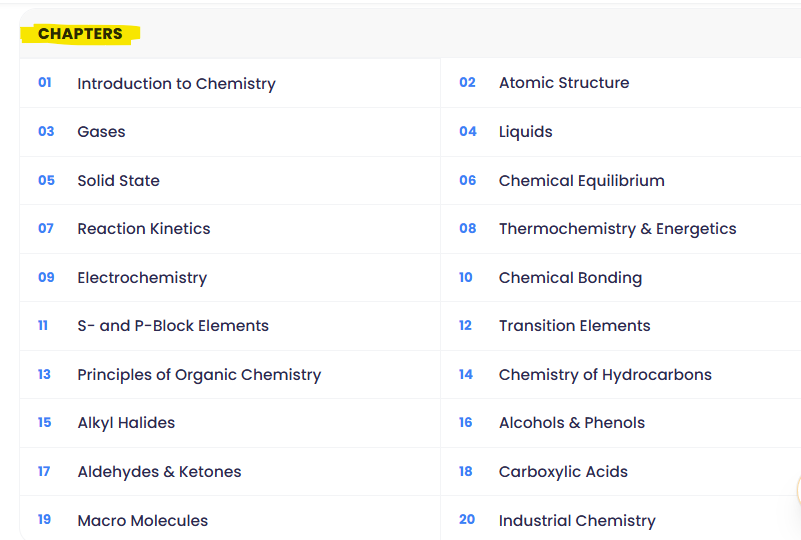
Accounting for 25% of the total paper with exactly 45 MCQs, Chemistry bridges the gap between raw conceptual understanding and rapid problem-solving. According to the Pakistan Medical and Dental Council (PMDC) national syllabus guidelines, the chemistry portion spans 20 comprehensive chapters across Physical, Inorganic, and Organic Chemistry.
PMDC MDCAT Chemistry Blueprint 2026
The PMDC keeps a highly predictable difficulty mix across the 45 Chemistry MCQs. Understanding this structural scale is your first step toward building a data-driven study schedule:
All 20 Chemistry Chapters & Official Learning Outcomes
The exam filters candidates strictly based on the official PMDC learning objectives. If a concept falls outside this framework, do not waste your time on it. Below is the master curriculum layout for 2026.
1. Introduction to Chemistry (Stoichiometry)
This is a calculation-heavy foundational chapter.
Learning Outcomes:
Construct mole ratios from balanced equations for use as conversion factors in stoichiometric problems.
Perform stoichiometric calculations with balanced equations using moles, representative particles, masses, and volumes of gases (at STP).
Explain the concept of the limiting reagent in a chemical reaction.
Calculate the maximum number of products produced and the amount of any unreacted excess reagent.
Calculate the theoretical yield, actual yield, and percentage yield given the balanced equation and starting reactant quantities.
2. Atomic Structure
Learning Outcomes:
Describe the discovery and properties of protons (positive rays/canal rays).
Define a photon as a basic unit of radiation energy.
Describe the quantum mechanical concept of orbitals.
Distinguish among principal energy levels ($n$), energy sub-levels ($l$), and atomic orbitals ($m$).
Describe the general spatial shapes of $s$, $p$, and $d$ orbitals.
Describe the line spectrum of the Hydrogen atom using quantum theory.
Use the Aufbau principle, the Pauli Exclusion Principle, and Hund’s Rule to determine and write the electronic configuration of atoms and ions.
3. Gases
Learning Outcomes:
List the core postulates of the Kinetic Molecular Theory (KMT) of gases.
Describe the chaotic motion of gas particles according to kinetic theory.
State the exact values of Standard Temperature and Pressure (STP).
Describe gas volume relationships using Boyle’s Law (pressure effects) and Charles’s Law (temperature effects).
Explain the physical significance of absolute zero, giving its value in degrees Celsius ($\text{-273.15}^\circ\text{C}$).
Derive the Ideal Gas Equation ($PV = nRT$) by combining Boyle’s, Charles’s, and Avogadro’s laws.
Explain the significance and different units of the ideal gas constant ($R$).
Distinguish clearly between real and ideal gases under varying pressures and temperatures.
4. Liquids
Learning Outcomes:
Describe macro-properties of liquids (diffusion, compression, expansion, molecular spaces, intermolecular forces, and kinetic energy) based on KMT.
Explain physical liquid properties like evaporation, vapor pressure, and boiling point kinetics.
Describe the nature of hydrogen bonding in $\text{H}_2\text{O}$, $\text{NH}_3$, and $\text{HF}$ molecules.
Explain the anomalous behavior of water when its density shows a maximum at $4^\circ\text{C}$.
5. Solid State
Learning Outcomes:
Describe properties of crystalline solids.
Name three distinct factors that affect the geometric shape of ionic crystals.
Give a brief description of ionic and molecular crystal categories.
Explain the structure of a crystal lattice and define lattice energy.
Define chemical equilibrium in terms of dynamic reversible reactions.
Write forward and reverse reaction paths and describe their macroscopic characteristics.
State Le Chatelier’s Principle and apply it to systems at equilibrium facing changes in concentration, pressure, temperature, or the addition of a catalyst.
Define and calculate solubility products ($K_{sp}$).
Define and explain the Common Ion Effect using specific analytical examples.
Define buffer solutions and explain the structural types of acidic and basic buffers.
Explain the industrial synthesis of Ammonia via Haber’s Process under optimized conditions.
7. Reaction Kinetics
Learning Outcomes:
Define chemical kinetics, rate of reaction, and rate equations (Rate Laws).
Determine the reaction order with respect to reactants and write corresponding rate equations.
Explain the meaning of activation energy ($E_a$) and the activated complex using energy profile diagrams.
Relate activation energy and the activated complex directly to the reaction rate.
Describe the role of the rate constant ($k$) in the theoretical determination of reaction velocity.
8. Thermochemistry & Energetics
Learning Outcomes:
Define thermodynamics and classify reactions as exothermic or endothermic.
Define the parameters: system, surroundings, boundary, state functions, heat ($q$), heat capacity ($c$), internal energy ($E$ or $U$), work done ($w$), and enthalpy ($H$).
Name and define the standard units of internal energy.
Explain the First Law of Thermodynamics as a law of conservation of energy ($\Delta U = q + w$).
Apply Hess’s Law of Constant Heat Summation to construct simple energy cycles (Born-Haber cycles).
Describe and compute the enthalpy of a reaction ($\Delta H$).
9. Electrochemistry
Learning Outcomes:
Give the defining characteristics of a redox reaction.
Define oxidation and reduction in terms of changes in oxidation numbers.
Use the oxidation number change method to balance equations and identify elements being oxidized or reduced.
Define cathode, anode, electrode potential, and the Standard Hydrogen Electrode (S.H.E.).
Define and explain the standard electrode potential ($E^\circ$) of an electrode.
10. Chemical Bonding
Learning Outcomes:
Use the Valence Shell Electron Pair Repulsion (VSEPR) Theory to describe molecular shapes.
Describe the structural features of sigma ($\sigma$) and pi ($\pi$) bonds.
Describe the shapes of simple molecules using orbital hybridization models ($sp^3, sp^2, sp$).
Determine molecular geometry based on the number of bonded pairs and lone pairs.
Predict molecular polarity from geometric symmetry.
Explain what is meant by the ionic character of a covalent bond (electronegativity differences).
Use molecular polarity knowledge to explain physical and chemical properties.
Define bond energies and explain how they compare the strength of different chemical bonds.
11. S- and P-Block Elements
Learning Outcomes:
Define periodic trends: atomic radii, ionic radii, covalent radii, ionization energy, electron affinity, electronegativity, bond energy, and bond length.
Recognize the demarcation of the periodic table into $s$, $p$, $d$, and $f$ blocks.
Describe the chemical reactions of Group I (Alkali metals) and Group II (Alkaline earth metals) elements with water, oxygen, and chlorine.
Describe the characteristic reactions of Group IV elements.
12. Transition Elements (d-Block)
Learning Outcomes:
Describe the ground state electronic structures of the elements and common ions of the $d$-block series (focusing on $3d$ series elements like $\text{Fe, Cu, Cr, Mn}$).
13. Principles of Organic Chemistry
Learning Outcomes:
Define organic chemistry, organic compounds, and functional groups.
Classify organic compounds based on structural frameworks (acyclic, cyclic, homocyclic, heterocyclic).
Explain stereoisomerism (cis/trans or geometric isomerism) and optical isomerism types.
14. Chemistry of Hydrocarbons
This is a massive, high-yield organic module.
Learning Outcomes:
Apply IUPAC nomenclature rules to alkanes, alkenes, and alkynes.
Define the free radical mechanism phases: Initiation, Propagation, and Termination.
Describe the mechanism of free-radical substitution in alkanes exemplified by Methane and Ethane halogenation.
Explain the shape of the Ethene molecule in terms of $\sigma$ and $\pi$ $\text{C-C}$ bonds.
Describe alkene reactivity and preparation methods (Dehydration of Alcohols and Dehydrohalogenation of Alkyl Halides).
Explain the structure of Benzene via molecular orbital treatment, defining resonance, resonance energy, and stability.
Compare Benzene reactivity with alkanes and alkenes.
Define addition and electrophilic aromatic substitution mechanisms in Benzene and Methylbenzene (Nitration, Sulfonation, Halogenation, Friedel-Crafts Alkylation, and Acylation).
Apply substituent positioning knowledge (ortho/para vs. meta directors) in electrophilic substitution.
Describe alkyne elimination preparation methods, acidity traits, and addition reactions (hydrogenation, hydrohalogenation, and hydration).
Differentiate clearly between substitution and addition reactions.
15. Alkyl Halides (R-X)
Learning Outcomes:
Name alkyl halides using the IUPAC system; discuss their structural polarities and reactivities.
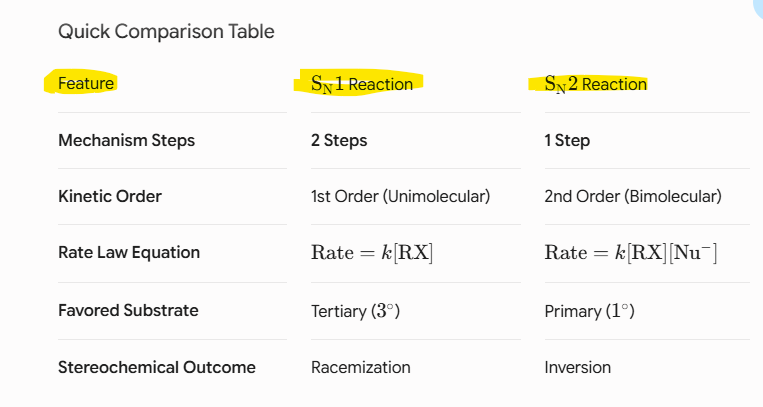
Describe the mechanisms, kinetics, and stereochemical pathways of Nucleophilic Substitution reactions ($\text{S}_\text{N}1$ vs. $\text{S}_\text{N}2$).
Describe the mechanisms and types of Elimination reactions ($\text{E}1$ vs. $\text{E}2$).
16. Alcohols & Phenols
Learning Outcomes:
Explain nomenclature, structure, reactivity, and preparation profiles of alcohols (including ether and ester synthesis).
Explain the nomenclature, structure, and acidic reactivity of Phenols, detailing electrophilic aromatic substitutions.
Differentiate analytically between an alcohol and a phenol (e.g., using $\text{FeCl}_3$ or acidity tests).
17. Aldehydes & Ketones
Learning Outcomes:
Explain IUPAC naming, structural traits, and preparation routes of carbonyl compounds.
Compare the relative reactivities of aldehydes vs. ketones.
Describe Acid-catalyzed and Base-catalyzed Nucleophilic Addition mechanisms.
Discuss carbonyl reduction to alcohols and specific oxidation profiles (Tollens’, Fehling’s, and Iodoform tests).
18. Carboxylic Acids
Learning Outcomes:
Describe IUPAC nomenclature, structure, acidity, and preparation paths of carboxylic acids.
Describe conversions to carboxylic acid derivatives: acyl halides, acid anhydrides, esters, and amides.
19. Macromolecules (Biochemistry)
Learning Outcomes:
Explain the classification, primary/secondary/tertiary structures, and function relationships of proteins.
Describe the structural role of proteins in maintaining bodily functions and their nutritional status.
Describe the specific action of enzymes acting as highly efficient biocatalysts.
20. Industrial Chemistry
Learning Outcomes:
Identify classification types and specific structural applications of industrial Adhesives and Synthetic Dyes.
Differentiate between condensation polymers (nylon, polyester) and addition polymers (polyethene, PVC).
High-Yield MDCAT Chemistry Mapping
To optimize your study strategy, categorize the 20 chapters into three operational blocks:
Mathematical formula applications, unit conversions, enthalpy cycles, and shape predictions.
~50% of portion
Inorganic Chemistry
Chapters 11 and 12
Electronegativity/ionization trends, group reactivity lines, and $d$-orbital configurations.
~15% of portion
Organic & Industrial
Chapters 13 to 20
Functional group transformations, reaction mechanisms ($\text{S}_\text{N}/\text{E}$), nomenclature, and polymers.
~35% of portion
Common Pitfalls to Avoid in MDCAT Chemistry
Even well-prepared students can lose critical marks due to systemic testing errors. Keep these troubleshooting rules in mind:
1. The “Unit Conversion” Trap in Gases & Stoichiometry
Mismatching Units in the Ideal Gas Equation (PV = nRT)
Troubleshooting Tip: Converting Pressure Units
2. Confusing SN1/E1 with SN2/E2 Rate Laws
3. Overlooking Reagent Identification Tests
PMDC regularly creates scenario questions like: “An unknown organic liquid gives a silver mirror with Tollens’ reagent but does not form a yellow precipitate with Iodine in NaOH. Identify the compound.”
Answer: It’s a non-methyl aldehyde (like Formaldehyde or Benzallehyde), as ketones fail Tollens’ and only methyl-carbonyls pass the Iodoform test.
Step-by-Step Preparation Model
To secure 40+ out of 45 marks in Chemistry without drowning in information overload, apply this exact model:
Isolate Calculations: Dedicate a specific notebook entirely to formula logs ($\text{pH, } K_c, K_{sp}$, Gas conversions, and Stoichiometric mass-volume bridges).
Map Out Reaction Flowcharts: For Organic Chemistry (Chapters 14-18), draw single-page master web diagrams showing how an alcohol can convert into an alkene, alkyl halide, aldehyde, or carboxylic acid. Visualizing functional groups as interconnected nodes prevents confusion on multi-step pathway questions.
Leverage Structured Digital Tools: Use platforms like the Maqsad App, where Sir Naved and premium educators break down these exact 20 chapters via objective-centered video lectures and a bank of 15,000+ chapter-wise practice MCQs to build your speed.
Final Thoughts
Chemistry is the differentiator on the MDCAT. While many students rely on rough guesswork for calculations or struggle to differentiate between meta-directing and ortho/para-directing groups, a student who approaches the 20 chapters systematically gains a massive competitive advantage. Master the official learning outcomes, memorize periodic trends, practice mechanism pathways, and use structural mock tests to lock in your medical college seat.