
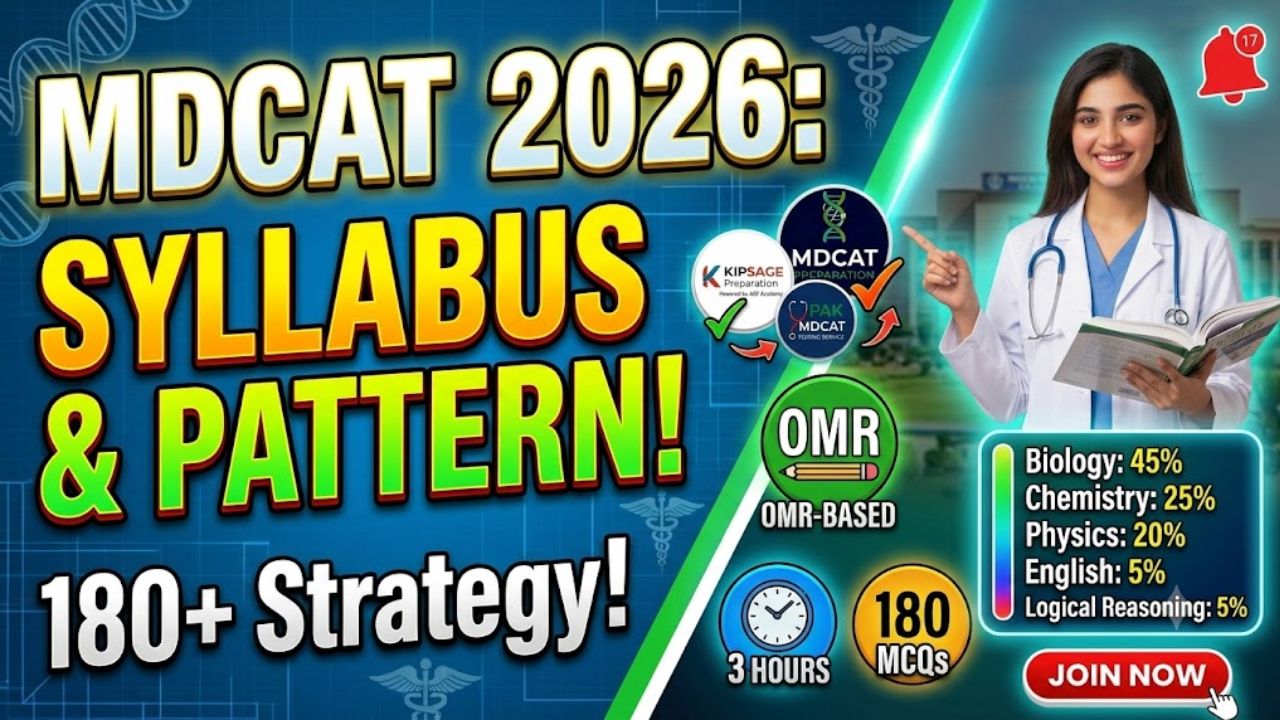
For medical aspirants in Pakistan, navigating the Medical and Dental College Admission Test (MDCAT) is the ultimate test of endurance, strategy, and academic precision. The journey toward securing an MBBS or BDS seat depends entirely on how thoroughly you understand what the Pakistan Medical and Dental Council (PMDC) expects from you.
I have broken down the official criteria to give you a definitive edge. If you are struggling with information overload, confused about policy changes, or trying to understand how to approach the revised difficulty distribution, this comprehensive breakdown is your step-by-step roadmap to conquering the MDCAT 2026.
What’s New in the PMDC MDCAT Syllabus 2026?
The biggest relief for MDCAT 2026 aspirants is stability. PMDC has officially announced that the MDCAT Syllabus 2026 remains unchanged from 2025. This means the targeted chapters, core concepts, and structural depth across all five subjects are identical to the previous cycle. You do not need to hunt for brand-new textbooks or stress over sudden omissions.
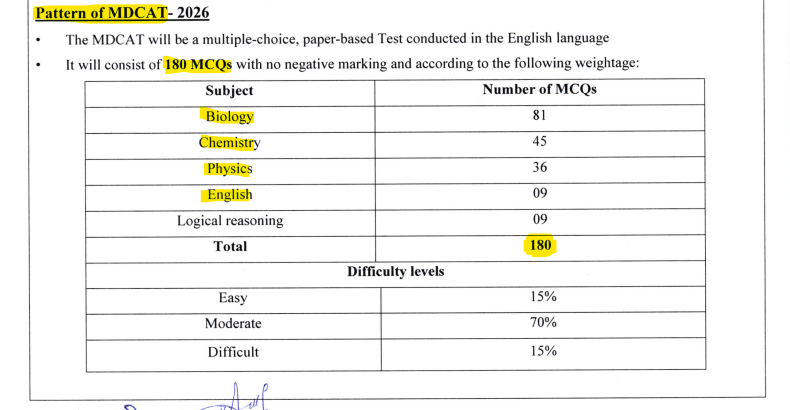
However, the challenge lies in the execution. PMDC has maintained a strict difficulty blueprint designed to separate superficial memorizers from conceptual masters. As shown in the official document image_edea27.png, the exam features a carefully calibrated structural mix:
- 15% Easy Questions: Direct definitions, straightforward book lines, and basic formula applications.
- 70% Moderate Questions: Conceptual applications, multi-step problem solving, and contextual reasoning.
- 15% Difficult Questions: High-order analytical thinking, intricate chemical pathways, complex physics calculations, and challenging logical fallacies.
The paper remains a traditional pen-and-paper, OMR-based exam. There is absolutely no online or computer-based testing component this year. You will read the paper booklet and manually fill in bubbles on a physical OMR response sheet using a pencil.
MDCAT 2026 Paper Pattern & Subject Weightage
To score exceptionally well, your study schedule must align perfectly with the marks distribution. You cannot afford to spend 50% of your prep time on a subject that only accounts for 5% of your final score.
The exam consists of 180 multiple-choice questions (MCQs) to be completed in a strict timeframe of 3 hours (180 minutes). This boils down to exactly 1 minute per MCQ—a metric that demands flawless time management. Crucially, there is no negative marking ($+1$ for a correct answer, $0$ for an incorrect or blank bubble), meaning you must attempt every single question before time runs out.
Also Read More About: PMDC MDCAT 2026 Test Centers Guide
As verified by the official PMDC notification matrix displayed in image_edea27.png, the subject breakdown is structured as follows:
| Subject | Total MCQs | Percentage Weightage | Primary Focus Areas |
| Biology | 81 MCQs | 45% | Human Physiology, Genetics, Cell Biology, Bioenergetics |
| Chemistry | 45 MCQs | 25% | Organic Chemistry mechanisms, Stoichiometry, Electrochemistry |
| Physics | 36 MCQs | 20% | Electromagnetism, Waves, Mechanics, Modern Physics |
| English | 9 MCQs | 5% | Vocabulary in context, Subject-Verb Agreement, Tenses |
| Logical Reasoning | 9 MCQs | 5% | Critical thinking, Letter/Number series, Logical deductions |
| Total | 180 MCQs | 100% | 3 Hours Total Duration (Paper-Based OMR) |
Step-by-Step Guide: How to Score 180+ in MDCAT 2026
Scoring above 180 is not a matter of luck; it is a clinical process of avoiding systemic errors and maximizing high-yield sections. Use this structured approach to optimize your preparation:
Step 1: Master the Textbook Lines First
PMDC questions are rooted heavily in provincial textbooks. Before jumping to advanced external prep materials or academy reference books, memorize and interpret your primary provincial textbook lines (e.g., Punjab Textbook Board, Sindh Textbook Board, or Federal/KPK boards depending on your region).
Step 2: Use the 1-Minute Rule in Practice Sessions
Because the paper gives you 180 minutes for 180 MCQs, you must simulate this exact pacing during your study sessions. When practicing chapter-wise MCQs via prep platforms like Maqsad—which offers over 15,000 curriculum-aligned questions, live classes, and timed mock exams—always set a countdown timer.
Step 3: Tackle the 70% Moderate Bracket
Do not spend weeks obsessing over overly obscure questions that fall into the rare 15% difficult bracket while ignoring core concepts. Securing a seat requires absolute perfection in the 15% easy and 70% moderate brackets, which together constitute 154 marks out of 180.
Troubleshooting the OMR Sheet: Common Mistakes to Avoid
The OMR (Optical Mark Recognition) grading machine is unforgiving. A single misplaced bubble can shift your entire sequence, ruining months of hard work. Keep these troubleshooting rules in mind:
- The Sequential Misalignment Error: Students often solve 10 questions in their test booklet and then transfer them to the OMR sheet all at once. If you accidentally skip a line (e.g., placing the answer for question 12 into slot 11), every subsequent bubble will be wrong. The Fix: Fill your OMR sheet question by question, or page by page at the absolute maximum. Always read the question number aloud in your head before filling the bubble.
- Incomplete Bubbling: If you light-pencil a circle, leave white space inside, or smudge the borders, the scanner will mark it as zero. Ensure the bubble is filled darkly and uniformly.
- Stray Marks: Avoid making any dot, slash, or calculation line on the OMR sheet area. The machine flags stray marks as grading anomalies.
PMDC MDCAT Syllabu Download in PDF
Frequently Asked Questions (FAQs)
What is the syllabus of MDCAT 2026 by PMDC?
The MDCAT 2026 syllabus is completely identical to the 2025 syllabus. It consists of specific core chapters from Biology, Chemistry, Physics, English, and Logical Reasoning. No new chapters have been added, and no existing modules have been altered.
Is MDCAT only MCQs?
Yes, the MDCAT is purely an objective-type test consisting of 180 multiple-choice questions. There are no short-answer questions, structural essays, or practical testing components on the exam day.
How should I prepare for the Logical Reasoning section?
The 9 Logical Reasoning MCQs assess your innate analytical skills rather than textbook memorization. Practice identifying patterns in number series, analyzing cause-and-effect statements, and resolving basic logical syllogisms during your weekly breaks.
Conclusion:
With the MDCAT 2026 syllabus confirmed as unchanged, your primary objective is to build consistent, timed testing habits. Avoid the trap of passive reading. Pivot your focus toward active recall, rigorous MCQ solving, and managing the physical constraints of an OMR paper format. Divide your daily routine to give heavy weight to Biology and Chemistry, practice high-yield physics numericals daily, and protect your mental stamina. Stay disciplined, trust the provincial textbooks, and execute your preparation systematically to claim your medical college seat.